The lighting method in Path of Exile 2 has left games entirely. Alexander Sannikov, Grinding Gear Games’ lead engine programmer, co-authored a paper applying radiance cascades to radiative transfer in astrophysics, including a model of a solar prominence. He walked through it in his talk, The Engine of Path of Exile, on Day 2 of ExileCon 2026. The same session produced the line that spread on Reddit: the engine team is six people, and Sannikov says the whole engine is “something like 250 kilobytes”. GGG used the slot to explain in public, for nearly an hour, how its rendering works, including debugging tricks Sannikov recommends to anyone writing their own engine.
The talk came after the ExileCon keynote and the developer Q&A.
Six engine programmers, and a 250 KB figure he didn’t define
Asked how the team keeps the game working as features are added, Sannikov said: “We have six people in engine team.” His explanation was restraint, because “there is a very large cost associated to adding more code into the engine.” Then came the line that spread: “Actually, our entire engine is something like 250 kilobytes. This is tiny. This is tiny by industry standards.”
The Reddit post saying the engine is “just 250KB and handled by just 6 people” reports his words correctly. What he never said is what the 250 KB measures: compiled code, source code, or only part of the engine. The talk’s opening slide is titled “Graphics Engine of Path of Exile 2”, which leaves room for the narrower reading, though his spoken words were “entire engine”. The top reply in that thread, at 192 upvotes, is skeptical: “A conventional game engine in ~250KB is doubtful”. We found no follow-up from Sannikov or GGG defining the number as of November 8.
It is also not the size of the game. Path of Exile 2’s Steam page asks for 100 GB of storage.
Both Path of Exile games compile from the same engine code
Sannikov said “we have literally the same engine” and that “any change that we do to POE2 is also automatically compiled for POE 1.” Consoles work the same way: he said most engine code is written once, with only the back end differing per platform. That shared base is how six people cover two live games on PC and console.
Path of Exile 2’s lighting converges in 1 to 2 milliseconds
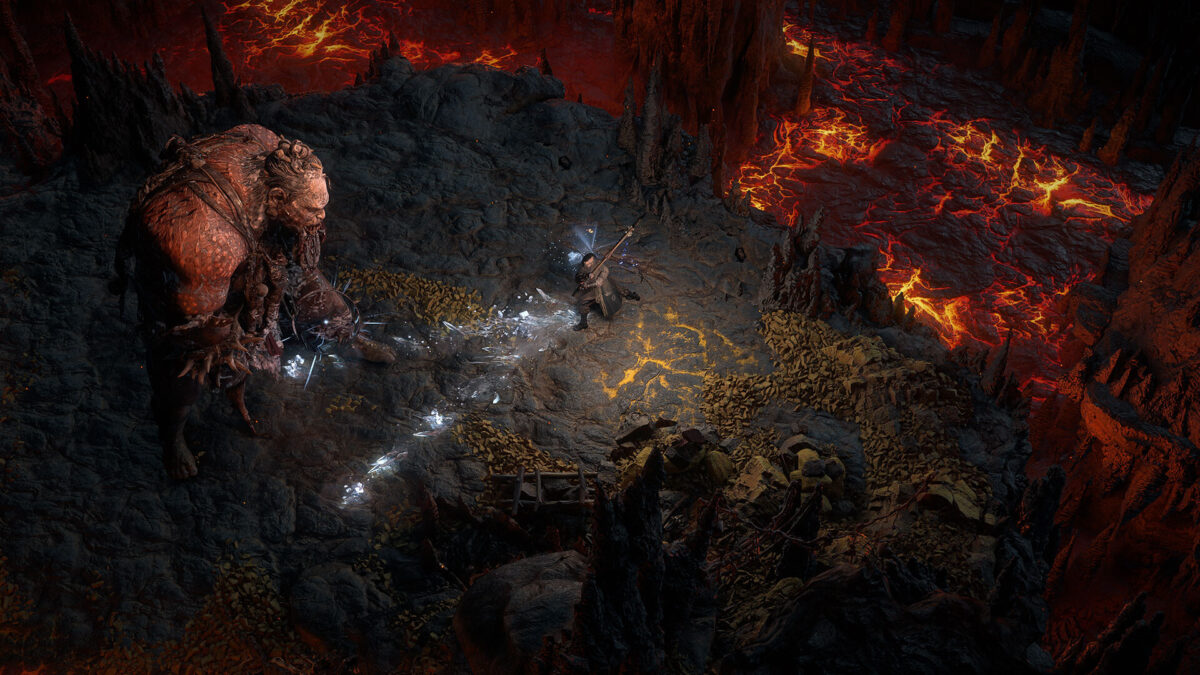
The lighting technique, radiance cascades, costs 1 to 2 milliseconds depending on hardware, and that cost does not change with what is on screen. “Whether there is like a 100 fireballs or one fireball or nothing happening, it’s always going to cost the same way,” Sannikov said. It uses no temporal accumulation, so light appears and vanishes the frame an effect does. He contrasted that with engines that quote 5 milliseconds per frame but need around 100 frames for the lighting to settle.
The algorithm behind that lighting reached a solar physics paper
Sannikov first showed radiance cascades at ExileCon 2023, and it has since left games. He co-authored a paper with Christopher Osborne applying the method to radiative transfer in astrophysics, including a model of a solar prominence. His explanation on stage was that light moving through a star and light reaching your eye are the same propagation problem.
He credited outsiders for the progress since 2023, saying the advancements “would not be possible without the community that formed around them”, and said a Discord of thousands of graphics enthusiasts now pushes the technique forward. He also said multiple games you can buy on Steam already use it.
Hardware ray tracing keeps the next version out of the game
A newer version called sparse radiance cascades works in world space, which removes the screen-space artifacts of the current method, but it runs slower, at about 5 milliseconds in the demo he showed. The blocker is hardware ray tracing, which he called “a very big commitment” because particles and skinned meshes are hard to fit into the acceleration structure it relies on. Asked when it ships, he said: “If we manage to get rid of that, we are golden.” His team is testing a cone tracing version without ray tracing. He called those results preliminary and gave no date.
No FSR 4 commitment: Sannikov cites closed source and motion vectors
The Q&A also took a question on what is holding back newer FSR versions. Sannikov said he dislikes that “they became closed source” and that they require motion vectors, “kind of a big commitment”. GGG already supports DLSS, which he said usually looks better, and consoles have their own upscalers, leaving “a bit of a strange niche that is left for FSR”. He did not announce a decision either way.
Some players took it as a no. A thread titled “No FSR 4+” says “we won’t get updated FSR for 1.0 release”. A reply in another thread asked for “elaboration” on why his objections apply to FSR “but not with DLSS that’s already in the game and shares these two traits.”
Crowds in the new acts are mostly copies that exist only on the GPU
GGG’s instancing lets one game object be drawn many times. In a crowd scene Sannikov showed, the CPU tracked “three or maybe five people” while the GPU drew hundreds, and he said “you’ll see more of this in the new acts”, meaning Acts 5 and 6 arriving December 11. Particle effects get the same treatment: a slam that he estimated would take tens of milliseconds on the CPU costs well under 1 millisecond on the GPU.
GGG says Linux already works and a Mac version is on its way
Sannikov said both games run “perfectly fine on any Linux distribution” that supports Steam, without SteamOS, and that he plays on Linux at home. His slide claimed identical performance. Steam’s store data still lists Windows only. On Mac, the session’s moderator said a version “is on its way” and needs more time, with no date.