


At first glance, Shipping Store Simulator 2037 looks like another entry in the increasingly crowded first-person business simulator genre. You inherit a shipping store, packages arrive, customers come looking for their deliveries, and most of your early time is spent physically doing the work yourself. Boxes need unloaded, shelves need stocked, customers need checked in, and payments need collected. It is familiar territory, and for the opening stretch there isn’t much to suggest just how far Playstrom intends to take the concept.
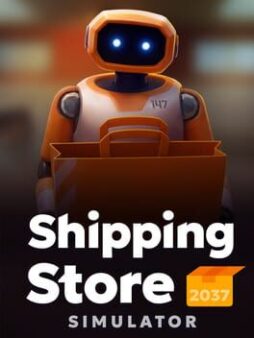
Then the robots start arriving.
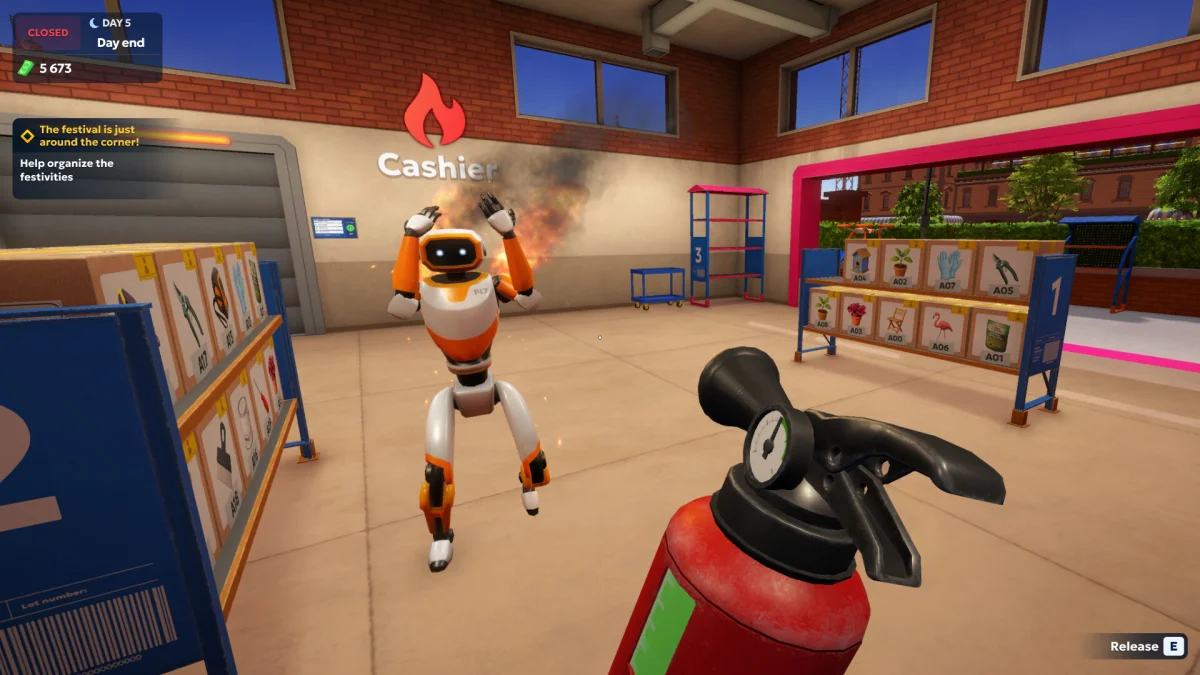
Before long, those robots are handling customers, unloading shipments, and stocking shelves. New sections of the warehouse open to support different types of deliveries. Drones begin flying packages across the city. Larger shipments go out by truck. You can hop into a van and personally drive around Cranelock, wrestle advertising territory away from competing businesses, take on side jobs for some surprisingly entertaining characters, and eventually work your way toward sending cargo into space.
That’s a much bigger game than I expected from something called Shipping Store Simulator 2037, and for most of my roughly 10-hour playthrough, discovering the next piece of that progression was enough to keep me invested.
Unfortunately, the more the business expands, the easier it becomes to see where the underlying balance hasn’t kept pace with the game’s ambition. Systems that initially feel like obvious upgrades can actually make your operation less efficient, automation never becomes quite as sophisticated as it should, and a surprisingly polished city becomes less relevant at precisely the point when your growing logistics network should make it more important.
Worst of all, after spending most of the game steadily increasing the scale of your operation, the final stretch feels strangely rushed. Shipping Store Simulator 2037 spends hours convincing you that there’s always another layer waiting around the corner, only to reach its biggest ideas and barely do anything with them.
Building a Shipping Business Is Surprisingly Satisfying
The core warehouse loop is easily the strongest part of Shipping Store Simulator 2037. Early on, you are effectively the entire company. When a delivery arrives, you’re the one unloading it. Packages need to be taken inside and placed on the appropriate shelves, customers need to be checked in at the counter, their parcels have to be retrieved, and payment needs to be processed before moving on to the next person.
None of those individual actions are particularly complicated, but they work together well. There is a satisfying physicality to handling the operation yourself, especially while the warehouse is still small enough that every decision about where to put something immediately affects how quickly you can find it again. What begins as simple busywork gradually becomes a basic logistics problem as the volume of deliveries increases and inefficiencies become more obvious.
What I especially liked is that automation doesn’t arrive all at once. Shipping Store Simulator 2037 doesn’t immediately give you a robot capable of handling the entire business while you stand around watching the money roll in. Instead, individual pain points are gradually removed. One of your first major automated workers can handle the customer-facing side of the business, checking customers in, finding their packages, and collecting payment. Later robots can unload incoming deliveries or stock shelves, and additional areas of the warehouse introduce their own specialized logistics requirements.
That pacing gives the progression a satisfying sense of escalation. Early automation feels valuable because you’ve personally experienced the work it’s replacing. When a robot takes over something you’ve already done dozens of times, it doesn’t feel as though the game is removing content; it feels like the business has genuinely become more capable.
At least initially.
Automation Never Becomes as Smart as the Business
The trouble is that the robots themselves don’t develop much after they’re introduced.
As the warehouse becomes larger and busier, I expected automation to become a deeper optimization system. Maybe I’d improve robot speed, carrying capacity, pathfinding, or task efficiency. Instead, most units remain largely static. In some cases, the primary way to improve throughput is simply to buy more robots.
That creates an odd disconnect between the fantasy of building an increasingly sophisticated futuristic logistics operation and the actual behavior of the machines running it. There were plenty of moments when I watched a robot complete a task slowly enough that I knew I could have done it considerably faster myself. Automation still has value because it frees me to work somewhere else, but it never quite develops into the finely tuned machine I wanted my warehouse to become.
The lack of meaningful robot upgrades becomes increasingly noticeable later because the game keeps adding more space and more work without giving those workers the tools to efficiently handle the additional distance. Instead of feeling like my automation was growing alongside the warehouse, it sometimes felt as though the warehouse was outgrowing the automation.
That problem feeds directly into one of the strangest balancing issues in the game.
Expanding Can Actually Make Your Warehouse Worse
Ordinarily, unlocking a larger building in a business simulator is an uncomplicated reward. More space means more storage, more equipment, and greater potential. In Shipping Store Simulator 2037, I eventually reached the point where expanding started feeling counterproductive.
The issue isn’t simply that I didn’t need all the additional room. Expanding the warehouse physically changes how far workers need to travel. Loading docks become increasingly distant from the front of the operation, which means robots unloading deliveries have farther to move before those packages can reach the shelves used by the customer-facing side of the business.
Suddenly, the larger warehouse I had worked toward wasn’t necessarily an improvement. It was introducing extra travel time into a system that didn’t have enough automation upgrades to compensate for it.
The same thing happened with shelving. More shelf space sounds inherently beneficial, particularly as the business grows, but spreading storage farther throughout the warehouse often meant robots spending even longer walking between destinations. I eventually found it more effective to keep much of my useful storage concentrated toward the front rather than fully taking advantage of the building I’d unlocked.
That undermines one of the fundamental pleasures of this kind of simulator. Expansion should introduce new logistical challenges, but solving those challenges should make the business better. Here, the smartest optimization choice can sometimes be to avoid using the very upgrades that are supposed to represent progress.
There’s an interesting warehouse-management game hiding inside that problem, but it needs another balancing pass. If larger spaces came with faster robots, better routing tools, conveyor systems, or other ways to compensate for increased travel distances, expansion could become a genuine optimization puzzle. In the current version, it too often feels like you’re being penalized for growing.
Cranelock Is Better Than the Game Lets It Be
Another pleasant surprise is how substantial the city surrounding your warehouse actually is.
Cranelock isn’t just a painted backdrop visible through the windows. Eventually, you can get into a van and physically drive through a fairly large city to make deliveries yourself. The driving isn’t especially complex, but it feels polished enough that leaving the warehouse becomes a welcome change of pace rather than a throwaway minigame.
More importantly, the existence of an actual navigable city gives the business a sense of place. The packages you’re moving aren’t disappearing into an abstract delivery screen. They’re going somewhere. There are businesses, streets, billboards, NPCs, and destinations beyond the walls of your warehouse, and that makes the growing logistics network feel considerably more tangible.
The frustrating part is that the game gradually gives you fewer reasons to engage with it.
As my warehouse became increasingly automated, I spent more and more time inside managing the operation. When I did leave, it was often only to jump into the van, drive directly to a marked objective, complete whatever needed doing, and head back.
That becomes particularly noticeable after unlocking drones and larger truck deliveries. These systems theoretically transform your company into something operating all across Cranelock, and the game is built so those deliveries actually exist out in the city. The problem is that by the time they’re functioning, I was rarely outside to see them.
I wanted some reason to experience the logistics network I’d built from the other side. Seeing my own trucks on the road, watching drones cross the skyline while handling another task, checking on delivery hubs around the city, or managing problems at remote locations could have tied the warehouse and Cranelock together much more effectively.
Instead, one of the game’s most polished features becomes increasingly disconnected from its primary loop.
The Competition Sounds More Important Than It Is
The rivalry with other shipping businesses has a similar problem.
On paper, competing for territory sounds like another layer of business management. Throughout Cranelock, rival companies control advertising space, and you can eventually interact with billboards to replace their advertisements with your own. Taking them over expands your influence across different areas of the city.
In practice, this is mostly another progression meter.
The actual process involves completing a very simple minigame at the billboard, after which the area effectively becomes yours. I never felt like controlling a neighborhood meaningfully changed the business. Competitors weren’t reacting to my expansion, customers weren’t behaving differently, and I didn’t have to adjust prices, delivery routes, or strategy based on who controlled nearby territory.
It’s another system that gives Shipping Store Simulator 2037 the appearance of being broader than it actually is.
That doesn’t make it unpleasant. Taking over areas gives you another objective while you’re already moving around the city, and watching your branding replace a rival’s fits the larger fantasy of building a logistics empire. It just never develops into actual competition.
The same game that does such a good job gradually layering new warehouse responsibilities could have benefited from treating its rivals as systems rather than milestones.
The Side Characters Are Better Than the Main Story
Ironically, some of the best reasons to explore Cranelock have nothing to do with the central business progression.
Several of the side characters have genuinely entertaining questlines. Their dialogue can be surprisingly clever, the situations occasionally get weird in entertaining ways, and I found that some of these smaller stories had considerably more personality than the actual main narrative.
That was one of the game’s more unexpected strengths.
Simulator NPCs often exist entirely to point you toward the next objective. They give you a task, you complete it, and they dispense whatever reward moves progression forward. Shipping Store Simulator 2037 has some of that, but enough personality comes through in its optional interactions that I actually became interested in seeing where certain characters’ stories were going.
Those quests also make better use of the city because they give you reasons to visit locations beyond the warehouse and ordinary delivery destinations. Cranelock feels most alive when you’re interacting with the people scattered throughout it rather than simply treating the city as pavement between objectives.
If anything, the quality of those moments makes the underuse of the city even more noticeable.
The Final Delivery Should Have Been the Beginning of Something Bigger
The biggest disappointment comes near the end.
Throughout Shipping Store Simulator 2037, each major milestone teaches you to expect another layer. Customer service expands into warehouse automation. Warehouse automation leads into different delivery methods. Vans give way to drones and trucks. The entire game establishes a pattern where each new system becomes something you can continue incorporating into the business.
Naturally, when I finally unlocked the ability to construct a rocket loading dock, I expected the biggest logistics system of them all.
Instead, I was essentially finished with it within minutes.
The rocket requires a collection of specialized materials that need to be gathered and loaded before launch. By the time I unlocked that part of the warehouse, however, my existing operation was already capable enough that meeting those requirements wasn’t particularly difficult. I gathered what I needed, filled the rocket, watched it launch, and that was effectively the entire mechanic.
It never came back.
There were no additional space contracts, no escalating orbital delivery requirements, no new materials being brought back from somewhere else, and no reason to incorporate rocket logistics into the business I’d spent the entire game building.
That’s a huge missed opportunity.
Space delivery doesn’t need to become an entirely separate game, but after spending hours progressing from manually handing someone a package to coordinating citywide transportation systems, launching a rocket should feel like the beginning of the ultimate tier of the company. Instead, it feels like a novelty included so the progression could technically end somewhere spectacular.
The actual ending suffers from the same issue.
Without spoiling anything meaningful, you’ll encounter a location relatively early in the game that can’t initially be accessed because it requires a specific code. Naturally, keeping that location inaccessible for most of the playthrough creates curiosity about what’s inside.
When the game finally answered that question, the payoff didn’t come close to matching the buildup.
There isn’t much to spoil, which is unfortunately part of the problem.
The final portion of Shipping Store Simulator 2037 feels noticeably less developed than everything before it. After spending hours constantly introducing new systems, the game reaches the moment when all that progression should culminate and instead seems to hurry toward the credits.
A Polished Game That Mostly Needs Better Tuning
What’s important is that these complaints aren’t coming from a game that’s fundamentally broken.
In fact, Shipping Store Simulator 2037 has an impressive level of polish for how many different things it’s attempting.
The warehouse interactions generally behave as expected. The robots function, even if their balance needs work. Driving around Cranelock feels good. The various delivery systems fit together without feeling like a collection of barely functional prototypes, and over the course of my 10-hour playthrough I never felt as though technical problems were constantly interfering with the basic experience.
That’s what makes its weaknesses feel fixable.
The issue isn’t that Playstrom’s ideas don’t work. It’s that some of them stop one stage before becoming genuinely compelling systems.
Give robots meaningful upgrades and suddenly warehouse expansion becomes easier to justify. Add stronger logistical tools and the larger building could become an optimization playground instead of a liability. Give me reasons to interact with deliveries throughout Cranelock and the city stops feeling disconnected from the business. Turn rocket shipping into an ongoing late-game system and the final progression suddenly has a reason to exist beyond one launch.
Most of the ingredients are already here.
They simply need better balance and, particularly toward the end, more depth.
Shipping Store Simulator 2037 Review Verdict
Shipping Store Simulator 2037 is much more ambitious than its straightforward title suggests.
What begins as a simple package-counter simulator steadily grows into a broader logistics game involving automated workers, warehouse expansion, vans, drones, trucks, city exploration, corporate territory, side stories, and eventually space delivery. For most of my roughly 10 hours with it, I enjoyed finding out which new system was going to become part of the operation next.
The core warehouse work is satisfying, and automation is introduced gradually enough that handing responsibilities over to robots initially feels like a reward rather than the game playing itself. Cranelock is surprisingly substantial, driving is polished, and several side quests give the world more personality than I expected.
The problems become more noticeable as those systems start interacting.
Robots don’t improve enough to handle the increasingly large warehouse efficiently. Expanding the building can actively lengthen workflows. Additional shelving sometimes hurts more than it helps. The city becomes less important precisely as your company develops the technology to operate across it, while the competitive territory system never becomes much more than another progression requirement.
Then the game reaches its final act and loses momentum entirely.
The rocket that should represent the culmination of your logistics empire amounts to a single delivery that can be completed almost immediately after unlocking it, while the final narrative payoff feels similarly underdeveloped. After spending most of the game making the next milestone feel exciting, Shipping Store Simulator 2037 ends just as its biggest ideas should be getting started.
There’s a polished, enjoyable logistics simulator here, and one that does enough differently to stand out among the endless stream of first-person business games. I enjoyed most of my time with it and genuinely wanted to see how far the operation could grow.
I just reached the end wishing the game had spent less time making the warehouse bigger and more time making its biggest systems matter.