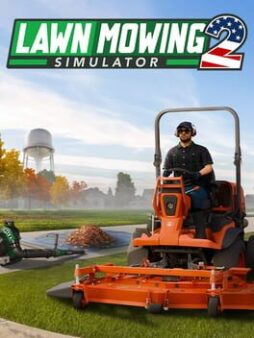



Lawn Mowing Simulator 2 should have been an easy sequel to recommend.
The original already established that there’s something strangely satisfying about meticulously working your way across an overgrown property, watching messy grass turn into clean lines one pass at a time. The sequel expands that idea with additional lawn-care jobs, more varied properties, new equipment, and an actual headquarters for your growing business.
On paper, that’s exactly what I wanted.
Unfortunately, after around ten hours, I had to stop playing.
Not because mowing lawns had suddenly become boring, but because Lawn Mowing Simulator 2 is currently in such rough technical shape that the relaxing experience it’s trying to create repeatedly collapses underneath bugs, collision problems, inconsistent cutting, performance issues, and some genuinely bizarre mower behavior.
There is a better sequel somewhere in here.
Right now, actually reaching it requires considerably more patience than mowing a lawn should.
Mowing Is Satisfying Until It Isn’t
When Lawn Mowing Simulator 2 works properly, I can see exactly why I enjoyed the original.
There is still a simple satisfaction to taking a messy lawn and systematically cleaning it up.
Pick a route. Lower the deck. Find a comfortable rhythm. Watch the uncut grass disappear behind you.
It’s mundane in exactly the way a good job simulator should be.
The sequel also introduces new grass technology designed to improve the appearance and behavior of lawns, alongside expanded lawn-care tasks beyond simply driving a mower around.
At its best, it works.
Then I’ll drive over a section of grass that looks like it absolutely should have been cut, only to discover that apparently it wasn’t.
That becomes a recurring problem.
Sometimes mowing registers exactly as expected. Other times I found myself making additional passes across sections I’d already covered because the game hadn’t properly recognized the cut.
That might sound like a relatively minor inconvenience, but this is a game where the primary activity is cutting grass.
When I can’t consistently trust whether the mower is actually doing that, the entire satisfaction loop starts breaking down.
Instead of looking at a finished lawn and enjoying the transformation, I’m wondering where the game decided I missed something.
The Mowers Have a Mind of Their Own
Far worse than inconsistent grass detection is the current mower handling.
I encountered one issue repeatedly where simply bumping into part of the environment could seemingly shift the axis of my mower.
Once that happened, everything felt wrong.
The mower would behave as though its orientation no longer properly matched where it visually appeared to be pointing, making basic movement incredibly frustrating.
And somehow, the best solution I found was essentially violence.
I’d deliberately slam the mower into something else and hope another collision would knock everything back into alignment.
Sometimes it worked.
Sometimes it didn’t.
Either way, deliberately crashing a mower into the scenery shouldn’t be an unofficial troubleshooting technique.
Collision problems extend well beyond that particular bug, too. Small environmental objects, terrain edges, and seemingly harmless contact could produce behavior that felt dramatically disproportionate to what actually happened.
Skyhook has already been patching collision behavior and mower handling. Its October 8 update altered collisions on certain walls, curbs, plants, and bushes while also improving performance and removing mower camera bounce. The developer also says it’s still investigating reports of mower sliding.
That’s encouraging for the future.
It doesn’t change the experience I had with the game that’s available now.
More Jobs Help Break Up the Routine
Not everything added in the sequel misses the mark.
One of its better ideas is expanding what actually constitutes lawn care.
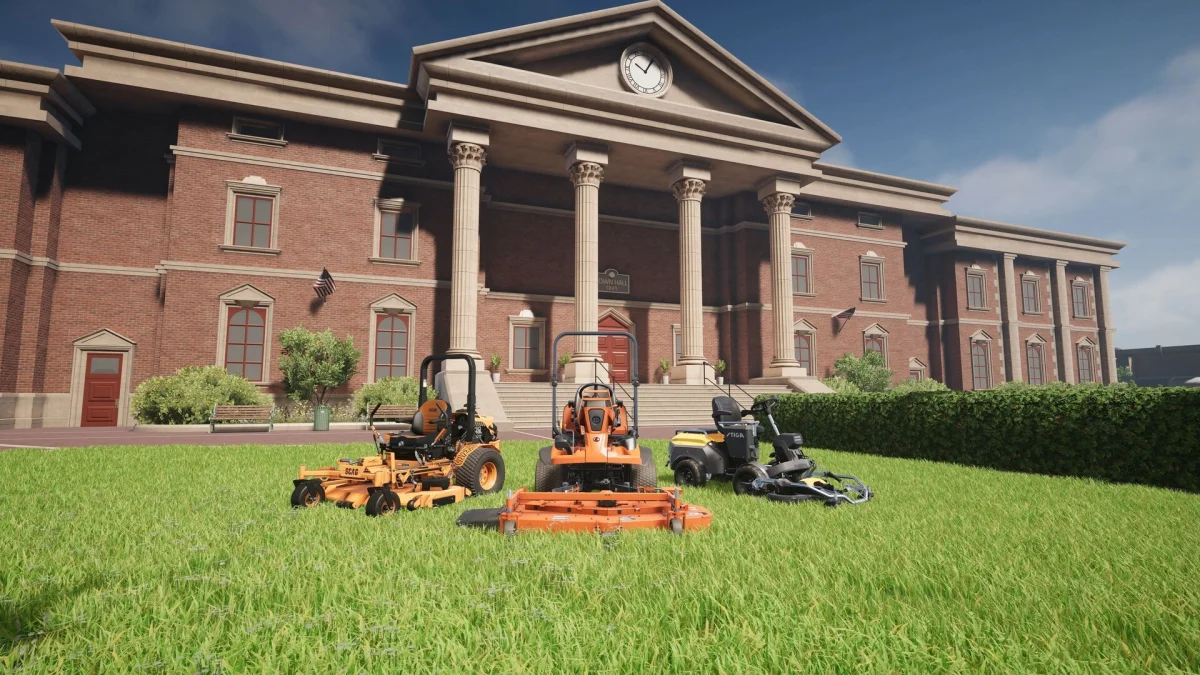
Contracts aren’t exclusively about climbing onto a mower anymore. Trimming, weed clearing, leaf blowing, debris collection, and other tasks help break up the routine. The game also features licensed equipment from Kubota, STIGA, and SCAG.
The additional work helps.
Even if many contracts eventually incorporate the same collection of activities, moving between them prevents every job from becoming one uninterrupted mowing session.
Leaf blowing was particularly satisfying when it worked.
Watching a pile gradually move where I wanted it and cleaning an area section by section scratches essentially the same part of my brain as mowing does.
Unfortunately, even that isn’t immune to technical problems.
I encountered leaves that appeared to glitch into environmental objects. Normally, scanning the environment can help identify anything you’ve missed, but leaves stuck inside something don’t always cooperate with that system.
Suddenly a relaxing cleanup job turns into a scavenger hunt for a piece of debris the game may have partially swallowed.
That’s really Lawn Mowing Simulator 2 in miniature.
There’s a satisfying activity here.
Then something breaks.
Finding One Blade of Grass Shouldn’t Be This Hard
Finishing jobs can become another unnecessary source of frustration.
When you scan for uncut grass, the remaining areas briefly appear in a bright blue highlight.
The problem is that cut grass itself can appear extremely pale.
Depending on the environment and lighting, that blue highlight can blend surprisingly well into the already light-colored lawn.
That’s manageable when you’ve missed a decent-sized patch.
It’s considerably less helpful when you’re searching an entire property for what effectively looks like a single blade of grass.
This is exactly the kind of quality-of-life system that needs to be almost impossible to misread.
If the game tells me I’ve missed something, the tool designed to find it should make the problem immediately obvious.
Instead, finishing the last fraction of a job sometimes becomes more tedious than completing the other 99% of it.
There’s a fundamental difference between methodical and frustrating.
A lawn simulator should understand that better than almost anything.
The Business Side Barely Matters
Outside of the actual lawn care, Lawn Mowing Simulator 2 also wants to sell the fantasy of running a growing business.
There’s a headquarters, staff, equipment purchases, contracts, upgrades, and the broader progression you’d expect from turning a small operation into something larger.
Unfortunately, very little of it felt meaningful during my eight hours.
The management systems are there.
I just rarely felt like I was making particularly interesting management decisions.
Hiring staff, upgrading equipment, acquiring different mowers, and progressing the company all function, but none of those systems significantly changed how I approached the game.
The equipment was especially disappointing in that regard.
New machinery should be exciting in a simulator built around using specialized equipment. I should be looking forward to earning enough money for the next mower because I know it’s going to noticeably change how efficiently or enjoyably I can tackle contracts.
Instead, much of the progression felt remarkably flat.
The economy itself is straightforward enough, but I never felt particularly invested in optimizing the company behind the jobs.
I’d rather have fewer management systems with meaningful decisions than a larger collection of systems that mostly feel like they’re present because a business simulator is expected to have them.
The Properties Are Better Than the Progression
I did appreciate the amount of variation within the properties themselves.
Individual contracts can change elements of familiar spaces, helping repeat visits feel somewhat different instead of simply asking you to mow the exact same layout again and again. Skyhook has also updated its contract generation since launch to increase location variety.
None of the locations I encountered were particularly memorable on their own, but they’re solid spaces for the type of work you’re doing.
Different obstacles and layouts force you to think at least a little about how you’re going to approach a yard.
Where can I comfortably turn?
Which areas should I trim manually?
What’s going to be annoying to reach with this mower?
That’s where Lawn Mowing Simulator 2 occasionally recaptures the quiet satisfaction I wanted from it.
Unfortunately, each new property also presents another opportunity for the game’s collisions, terrain, cutting detection, or performance to cause problems.
Relaxation Shouldn’t Be This Stressful
Technical problems are ultimately what define my experience with Lawn Mowing Simulator 2.
I encountered frame drops.
I encountered strange terrain behavior.
I encountered frequent collision issues.
I had leaves behaving incorrectly.
I had mowing that didn’t always appear to register reliably.
And I dealt repeatedly with the mower-axis issue that could transform a perfectly normal contract into a fight against my own equipment.
I played with mouse and keyboard. Skyhook recommends using a controller, and the game offers full controller support.
But input preference doesn’t explain away the broader physics, collision, detection, and performance problems I encountered.
Steam reception reflects a similarly rough launch. As of this review, user reviews remain Mixed, with fewer than half currently positive.
More importantly, Skyhook is actively releasing patches, which gives me some confidence that the game I played won’t necessarily be the game someone experiences several months from now. The October 8 patch alone targeted optimization, collisions, contract generation, progression issues, and mower behavior.
I genuinely hope they get there.
Because I can see the game this is trying to become.
Lawn Mowing Simulator 2 Review Verdict
The most frustrating thing about Lawn Mowing Simulator 2 is that I don’t think its underlying ideas are bad.
In several ways, it’s trying to be exactly the sequel I wanted.
More varied lawn-care tasks help break up mowing sessions. Properties have enough variation to prevent every contract from feeling identical. Leaf blowing can be satisfying. The core experience of transforming an overgrown lawn into something clean and orderly still works when the game gets out of its own way.
It simply doesn’t get out of its own way often enough.
A relaxing simulator depends heavily on consistency.
The mower needs to behave predictably.
The grass needs to register when I cut it.
The collision system needs to make sense.
The tools designed to help me find unfinished work need to actually help me find it.
And most importantly, I should be thinking about how I want to tackle the lawn rather than how I’m going to fix whatever just happened to my mower.
After roughly eight hours, I reached the point where the frustration outweighed the relaxation and stopped playing.
That’s not where I expected to land with a sequel to a game I already enjoyed.
At $29.99, I can’t recommend Lawn Mowing Simulator 2 in its current state.
Skyhook is actively patching it, and there is enough promise underneath the problems that I could absolutely see revisiting this review once the game is in better shape.
But reviews have to evaluate the game that exists now, not the one that might exist after another few months of updates.
Right now, this lawn needs a lot more work.