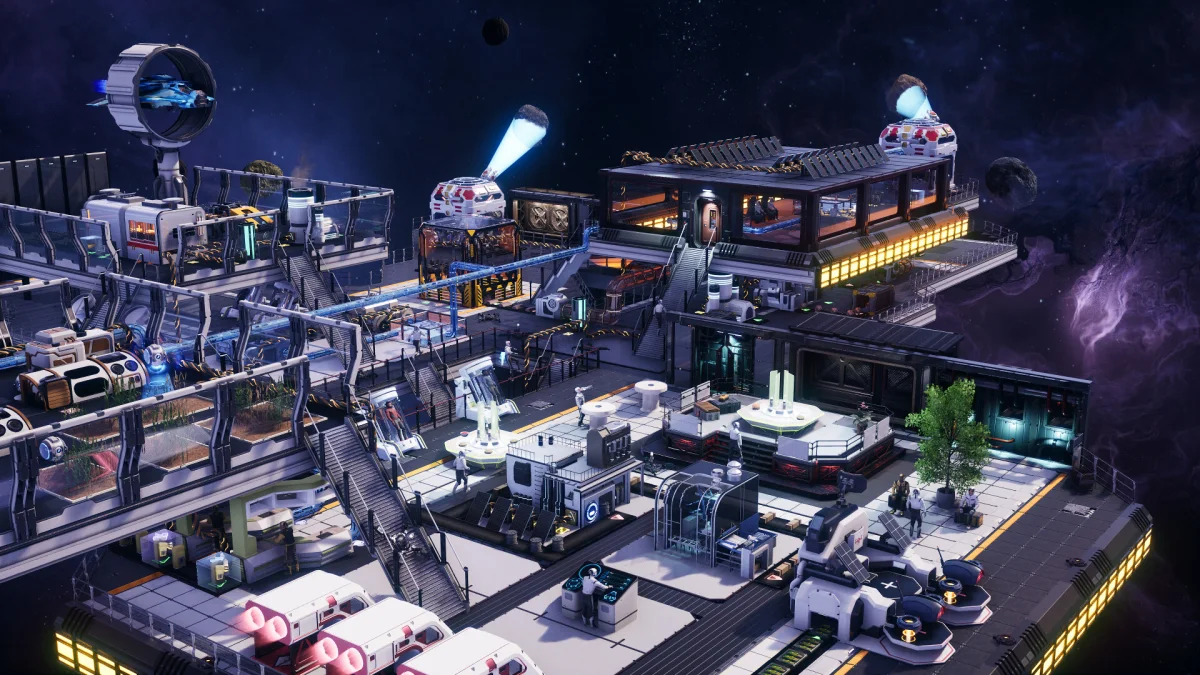
You build a smelter, run a belt into it, run a pipe out of it, and then you fly the whole thing somewhere else. That’s the pitch. In Astro Colony your production lines sit on modular space stations that have engines, so the factory you spent an hour laying out isn’t a permanent installation on a permanent map. It’s a vehicle. You chew an asteroid down to gravel with a mining tool that actually removes voxels, and when the rock is spent you don’t build a longer belt to the next patch. You throttle up and go find one.
That single design choice reorganizes everything else, and it’s why Terad Games’ sandbox is worth your twenty bucks even while it’s tripping over its own control scheme.
Your Factory Has a Throttle Now
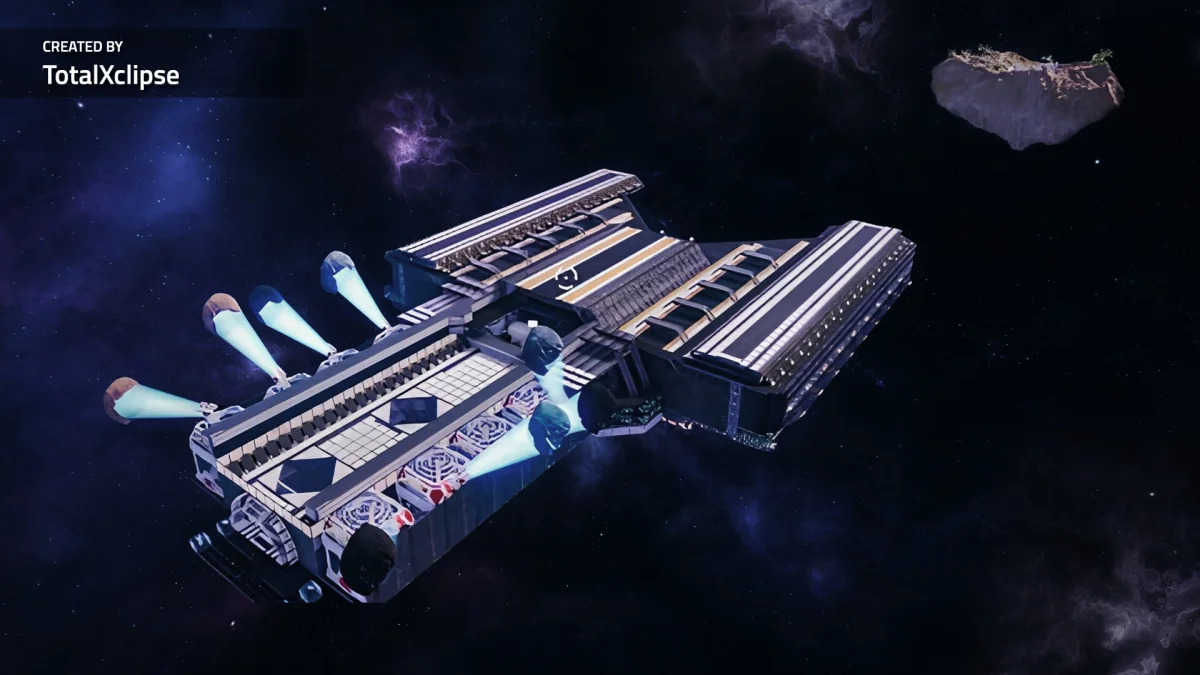
Static factory builders train you to think like a city planner: claim ground, sprawl outward, never stop. Astro Colony trains you to think like a road crew. Because stations move and dock together into a growing colony network, the real skill isn’t sprawl, it’s modularity. You start asking whether your ore processing should live on the same hull as your food production, or whether it should be its own unit you can detach and park somewhere useful.
Docking is where the good decisions live. A colony that’s one enormous welded lump is easy to build and miserable to reconfigure, and you’ll feel that the first time you need to send half your infrastructure two systems over. Fully destructible voxel worlds do the other half of the work. Mining here is excavation, not clicking a resource node until a number goes up, so hollowing out an asteroid and watching your silhouette get carved into it makes exploration feel like you earned the next biome instead of unlocking it.
Belts, Pipes, and the Stuff Nobody Explains
The tech tree runs past 70 researchable technologies and it’s paced like a band that knows how to open a set. The early hours hand you toys instead of homework, which is a real departure from genre rivals that make you hand-craft your first thousand items as a hazing ritual. Players coming off the bigger automation games consistently flag the front end here as less tedious, and they’re right.
What the game refuses to do is teach you logistics. Belt splitting, routing, the actual rules governing how items divide and merge: you’re reverse-engineering that stuff by experiment, because the game doesn’t sit you down and explain it. If you’ve internalized Factorio’s splitter behavior you’ll assume Astro Colony works the same way, and you’ll be wrong in ways that are hard to diagnose. That’s the most common complaint from people who bounced off.
Once the splitters do click, though, the throughput itch gets properly scratched. Pipes and belts feeding a chain of production onto a hull you can pilot is a genuinely different puzzle than anything Satisfactory asks. The knock is how long the clicking takes, and how much of it happens through trial and error rather than design.
Keeping Astronauts Alive Is Its Own Full-Time Job
Recruiting crew turns your factory into life support. Astronauts need food, oxygen and housing, which means every optimization decision has a body attached to it. Your belts aren’t feeding a score counter, they’re feeding people who will die if you overcommit your resources to research and forget the greenhouse.
Hazardous events are what stop you from running everything at razor thinness. Optimize a supply chain down to zero slack and one bad event will introduce you to the concept of redundancy, hard. It’s a good tension: the survival layer punishes exactly the min-max instincts the automation layer rewards, so you’re always negotiating between elegance and insurance.
Online co-op splits the work cleanly, with one player scouting and hauling stations while the other keeps production fed, and Steam Workshop support means the shelf life extends past whatever the base game hands you. There’s a narrative thread and stargate content in here too, which most players seem to reach well after they’ve stopped thinking of this as a building game.
Death by a Thousand Keybinds
The interface is the weak link, and with this many build modes it’s not a small one. There are too many keybinds spread across too many contexts, and the back function behaves differently depending on where you are, so pressing escape to leave a build mode may just yank up the main menu instead. In a game already asking you to track crew needs, production ratios and a station’s flight path, having to fight the menus for the privilege is a legitimate reason people put it down in the first three hours.
Inventory friction compounds it: none of this is broken, it’s just unsanded, and it’s the difference between a 7.5 and something closer to an 8.5.
Performance is the opposite story. It runs clean, including on rigs several generations back, which for a voxel sandbox with destructible planets and multiple docked stations is a real engineering flex. The developer is also visibly active with the community, and post-Early-Access reception has been Very Positive, roughly 1,200 thumbs up out of about 1,500. I’m not grading on a curve for future patches, but I’d bet on this one.
Worth the Launch Window?
If you like automation games and you’re the type who enjoys figuring out an undocumented system by poking at it, twenty dollars for this is highway robbery in your favor. If your tolerance for clunk is low, if you want Satisfactory’s onboarding and menu discipline out of the box, skip it for a couple of patch cycles and let the keybinds get sorted.
Nothing else lets you strip a planet to rubble, dock your smelter to your greenhouse, and drive the whole operation to the next star.