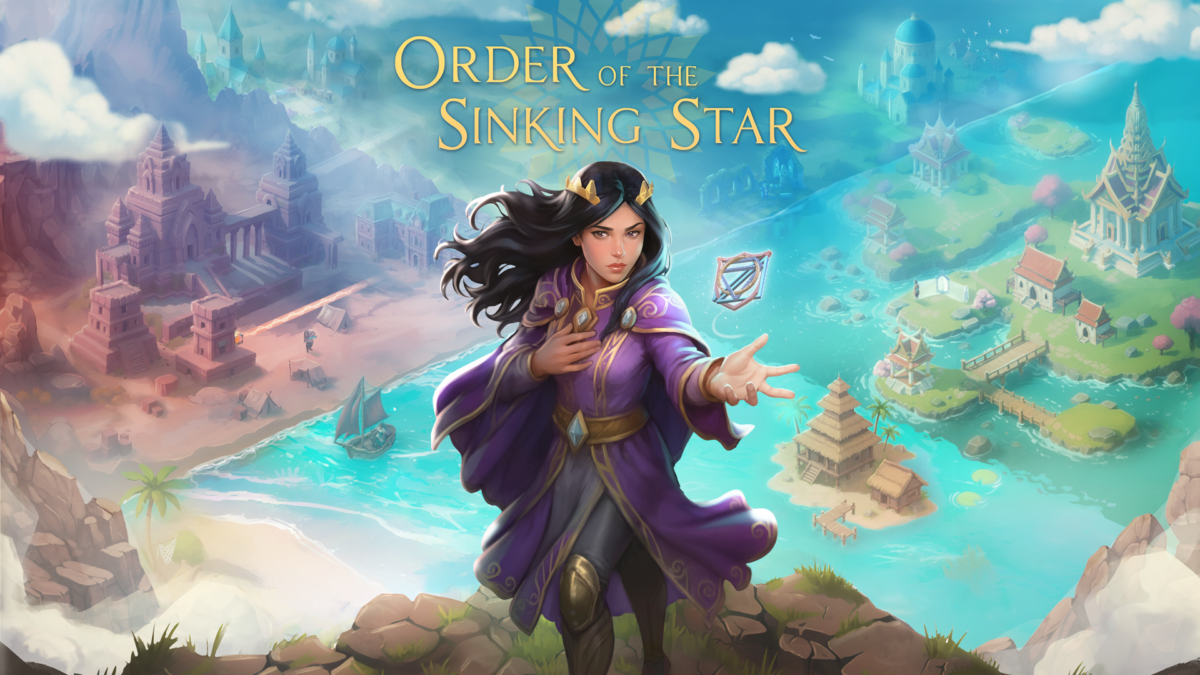
Jonathan Blow has never seemed especially interested in making games the easy way. From Braid to The Witness, his work has consistently chased ideas until they reach their fullest expression, even when that means years of design iteration, technical reinvention, and more puzzles than anyone probably expected at the start.
In a conversation with Output Lag, Blow walked us through the design philosophy behind his latest Sokoban-inspired puzzle project, Order of the Sinking Star, highlighting the challenge of combining multiple worlds of mechanics, why “bad difficulty” has to be cut, and how building a new programming language and engine changed the way his team works.
OUTPUT LAG: One thing that immediately stood out from the footage is how naturally the Sokoban-style format seems to fit this game. It feels like a great choice for the world, especially with the four different worlds and mechanics you’re working with. What made that structure feel right?
JONATHAN BLOW: One of the nice things about the Sokoban format is that you can drop different kinds of mechanics into that square-based world and they still make sense. If you imagine trying to combine something like Doom with an RTS, for example, that becomes much harder. You can’t just take things from one game and drop them into another without designing an entirely separate game around it.
With this format, you actually can do that. The game is about interesting mechanics, and about what happens when they combine in surprising ways. There’s also something useful about the abstraction of a grid-based game. A character can stand for an ability, like teleportation. A monster can stand for a specific threat, like killing you if you stand next to it. We’re not overly concerned with the exact physical realism of every object because the format is already somewhat abstract. I like that effect a lot for this game.
OUTPUT LAG: You’ve said before that the four individual worlds only account for a small percentage of the total game compared to what happens when those worlds start mixing together. From a design standpoint, how do you even approach something on that scale? Even that first five percent looks bigger than most games.
JONATHAN BLOW: The trick is to convince yourself at the start of development that it isn’t going to be that big of a game. If you knew how big it was going to be, you probably wouldn’t do it.
At the beginning, I thought it would be smaller. My mindset was that because we were starting with established mechanics and established puzzles, we could lean on those, add some new things, and it would be a smaller game. But what happens every time is that I see the potential for the best version of something, and then I want to do that.
Once we started making this game, I felt like if we were going to combine the worlds, we should do a really good job of it. We could have combined them a little bit, made a few puzzles, and said, “Okay, that’s enough.” But I’ve talked before about how games that explore ideas feel better when they explore the full possibilities. That doesn’t mean you show players everything or bore them with every variation, but as the designer, you search through all the possibilities, find the best ones, and collect those into the game.
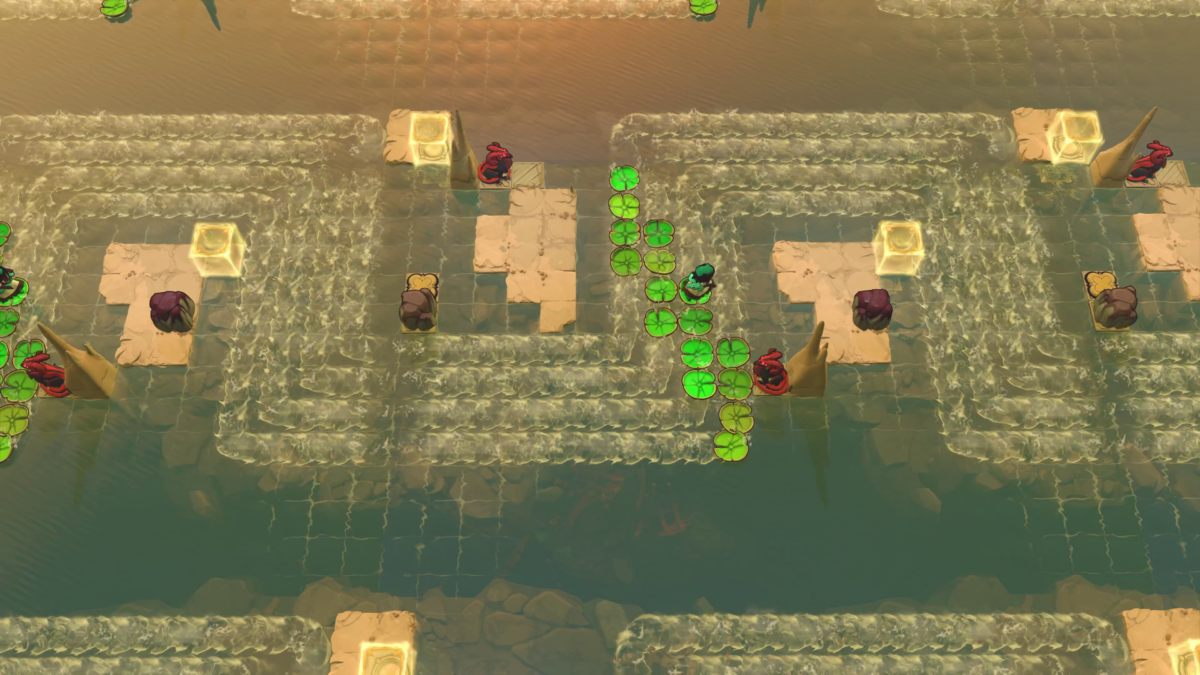
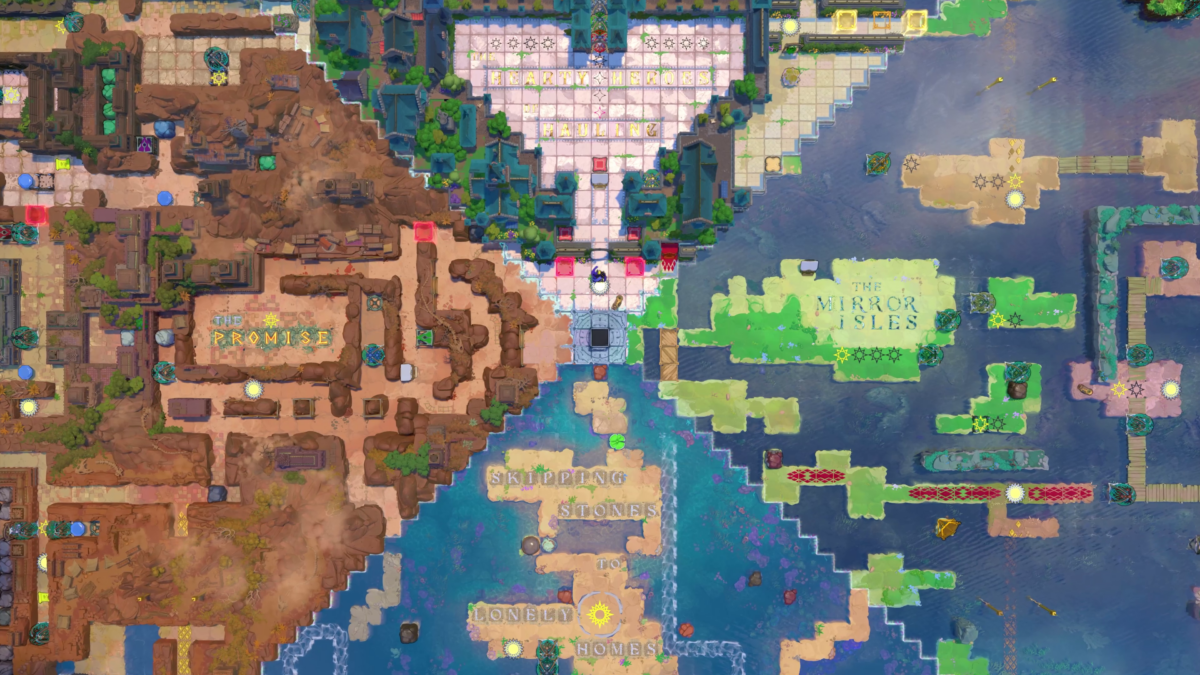
That’s why the game is so big. You can actually see it geometrically on the overworld map. The rows of rooms going north are one campaign. The east axis is another world. Then the combinations start filling in the northeast, northwest, southeast, and so on. Those combination areas are much larger because combining mechanics generates so much more material.
A lot of people have told me, “Why don’t you break this into three games?” or “Why not make some of it DLC?” But I just want to make the good version of the game. I think players want the good version, not the half-version.
OUTPUT LAG: As a player, that’s refreshing to hear. It feels rare right now to hear someone say, “No, this is the finished product. This is the whole thing.”
JONATHAN BLOW: Yeah.
OUTPUT LAG: Puzzle games are a love-hate thing for me. I get frustrated easily, but when I finish a really tough one, it can feel like a Dark Souls-level accomplishment. With this game, if completionists are looking at hundreds of hours, I may be in trouble — but I’m looking forward to jumping in.
JONATHAN BLOW: We do a lot in the design to try to minimize frustration. I play a lot of puzzle games, and I enjoy them, but while we were deep in development, I’d sometimes play someone else’s puzzle game and think, “My brain is tired. I don’t want to guess. This isn’t fun right now.”
That made us very aware of the same phenomenon in our own game. It’s a puzzle game, so there should be challenge. You don’t just want to give players the answer. But we realized that a lot of games, including ours early in development, add challenge that isn’t really necessary, isn’t on topic, and isn’t even that interesting.
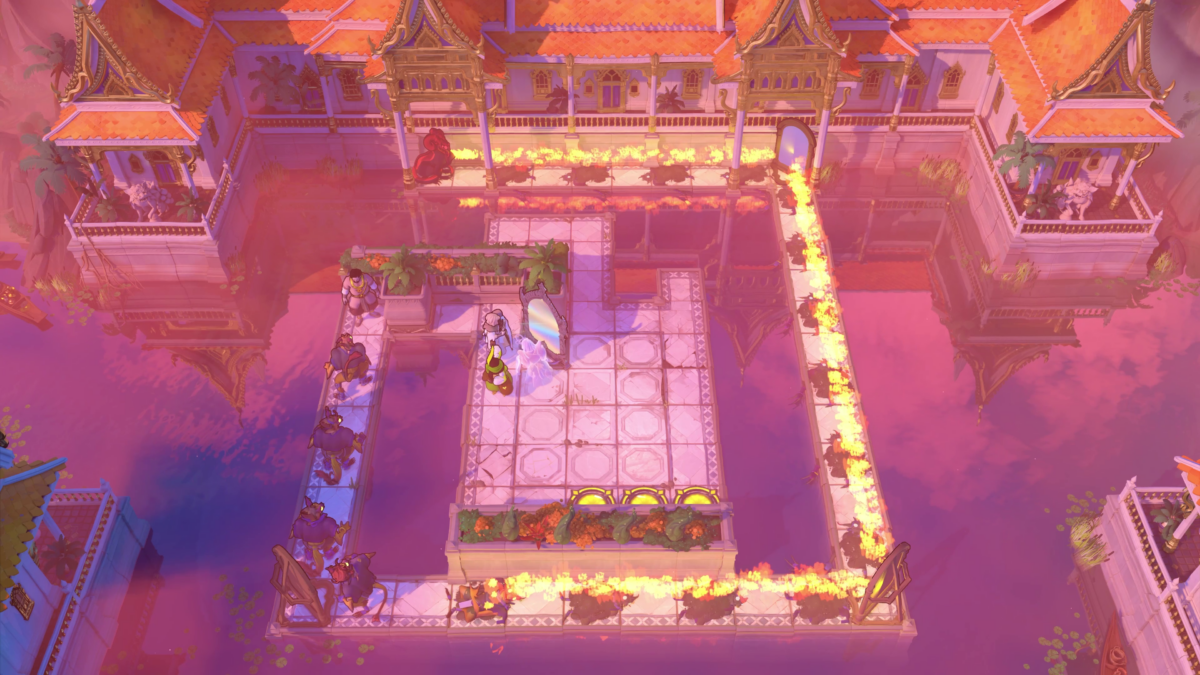
For example, there might be a puzzle where the real idea is that you need to use a magic mirror to teleport a crystal into a specific spot so you can cross to the target. That’s the interesting idea. If you know what to do, setting up the solution shouldn’t take a lot of tedious object pushing. Early on, we were in this mindset of, “It’s a Sokoban game, so if you need to move a crystal over there, we should make it hard to move it over there.”
But after doing that enough times, and after feeling tired playing both other people’s games and our own, I made a design decision halfway through development: we’re not going to do that anymore.
There is good difficulty, but it has to be connected to the topic of the level. If I understand what I’m supposed to do, and I see exactly what I need to do, but something specific is preventing me from doing it, that can feel intentional and well-designed. But if I don’t know what I’m supposed to do, and I’m just pushing objects around, getting frustrated, and wandering randomly, that’s bad difficulty.
We’ve been pretty ruthless about trimming out the bad difficulty and leaving the part of the puzzle that’s actually fun and on topic. At least, that’s the goal. Players will be the judge of whether we succeeded.
OUTPUT LAG: That sounds great, because that’s exactly the kind of thing that can wear me down in puzzle games. If my brain gets too overworked, I need a break. Stepping outside the puzzle mechanics a little bit, what is there beyond the puzzles in terms of story and world? What is at the heart of this game?
JONATHAN BLOW: The puzzles themselves are not just about difficulty. They’re about ideas. That also applies at a meta level.
As you play, you start building a map in your head of what the ideas are. It’s not just one puzzle with one idea. The ideas are grouped together. When you play through a sequence of puzzles, it almost becomes a little puzzle narrative. You see multiple related ideas develop in sequence.
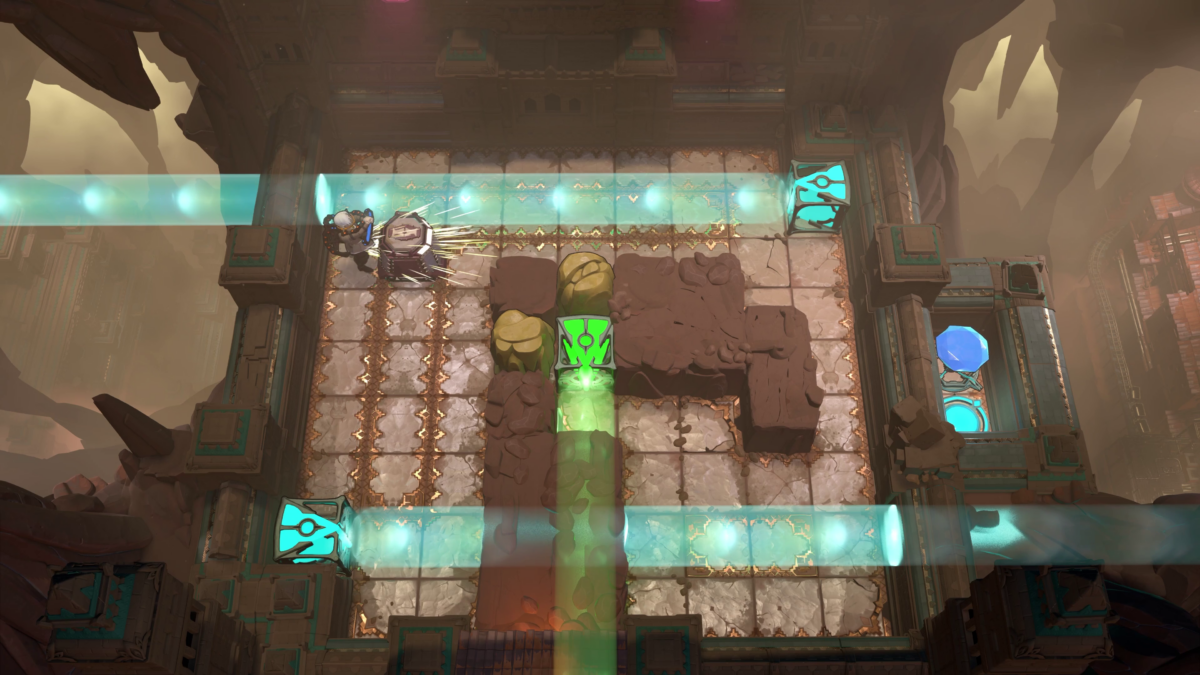
For example, there may be a set of rooms about green beams that let you walk through walls. The levels in that section are grouped around that idea, which helps you understand what you’re expected to do and helps you see the pathway through the mechanics.
Then there’s also story layered into the levels. Often when you enter a level, you’ll get a small story exchange. It might only be four or five sentences, but that’s typical. As you play through a series of levels, those little conversations add up. They give you a picture of the world the characters are from, who those characters are, what they’re trying to do, and how they relate to each other.
This game actually has more explicit story than either The Witness or Braid. Braid had some explicit story, but it was compact and compartmentalized. It happened before you entered the levels. In this game, the story is sprinkled throughout the levels as you play.
OUTPUT LAG: Looking at the overworld, you mentioned how different directions represent different worlds and how those worlds overlap. Is there also a combination where north meets south?
JONATHAN BLOW: That’s a great question. You’re the first person who’s asked that.
The surprise is that, at the beginning, you don’t know the overworld wraps around. The map starts out fogged, and as you explore, it pulls back. Eventually, you discover that the world wraps. So where east needs to meet west, it does. Where north needs to meet south, it does.
It’s one of those things that’s a fun surprise for players to discover, but it also follows naturally from everything the game has already been doing.
OUTPUT LAG: That’s awesome. I feel dumb for not seeing it, but that’s really cool.
JONATHAN BLOW: It’s meant to be discovered. I’m so used to it now that I almost forget to mention it, but it is a cool thing when players find it.
OUTPUT LAG: On the technical side, with this game you’ve essentially built a new engine and a new programming language, right?
JONATHAN BLOW: Yeah. It was a lot of work.
OUTPUT LAG: I work a lot with AI in my day job, and as a hobby I’ve been trying to use it to teach myself more about the technical side of game development. Even from that small perspective, I can only imagine how much complexity there is in making sure all of this works.
JONATHAN BLOW: Games have a huge complexity that sneaks up on you. They’re all about things interacting in a world, and that gets complicated very quickly.
Even if you’re “just” an animator working on character animations, you run into questions like: what happens when the character is facing a corner, someone freezes him, and we don’t want his arm sticking through a wall? Games are full of those situations.
That’s also what makes them fascinating. It’s a very rewarding discipline to work in.
OUTPUT LAG: Were there any big takeaways from building the game alongside a new language and engine? Did that fundamentally change how you look at game design?
JONATHAN BLOW: Some of it was less about changing my mind and more about validating ideas we already had going in.
Part of the reason I made a new programming language was that I was frustrated by the speed of the systems I had been using. When we were working on The Witness in C++, things got bogged down toward the end. That happens on any game. By the end of development, you have the most graphical assets, the most maps, the biggest bug list, and the most material to deal with. At the start, everything is fast because you’re making things from nothing.
On The Witness, compiling the game could take around four minutes. That might not sound terrible, and it’s actually faster than what a lot of triple-A studios deal with. Earlier in my career, I worked on an Unreal Engine game where compiling could take 45 minutes. But even four minutes adds up.
With the new language, one of the goals was to make it really fast to try things. If I make a change in the code and build the whole game, it takes around two seconds. I wanted it to be one second, but two seconds is still a lot better than four minutes. It’s about 100 times faster.
If you wait four minutes 100 times a day, that’s hundreds of minutes wasted. You end up losing most of your day, and it stops being fun. Theoretically, we make games because we like games and want them to be cool. Waiting all the time is frustrating.
That’s been the biggest thing. But when you make an engine from the ground up, there’s a lot to think about. You gain a new level of respect for what’s inside a video game and everything it’s doing.
I don’t think we’ll do it again after this, because graphics technology has sort of stopped changing in the same way. Our current engine should be good for a couple more games with some improvements. I like large, ambitious technical endeavors, but they take a long time and they’re tiring. After this, I’d like to make more games faster. Not slop them out, but a good three-year development would be nice instead of a 10-year development.
OUTPUT LAG: Now that you have your own engine and know it inside and out, that should help.
JONATHAN BLOW: It should, but I hesitate to be too ambitious about setting a short schedule. There are always reasons things take longer.
OUTPUT LAG: I’m always a victim of scope creep, so I understand that. Another unique thing about this project is that it seems like your most collaborative game. Braid and The Witness were more solo-driven, right?
JONATHAN BLOW: Braid was mostly solo. I had some people helping, most notably David Hellman doing the 2D art, but the programming, engine, and game design were all me.
For The Witness, I did almost all of the game design and basically all of the gameplay programming, but we had more of a team for things like the graphics engine and console work.
With this game, we started with a decent-sized team. Tiny compared to triple-A, but around ten people, because that’s who we had from The Witness. So we had a team from the start rather than just me.
The design has also been more collaborative. That applies both to the game designs we started with to make the four worlds and to the day-to-day process now as we finish the game. I work with other designers on individual levels, polishing them and making them as good as possible. That’s something I didn’t really do on previous games.
OUTPUT LAG: From a creative standpoint, do you enjoy that bigger collaborative process more, or do you prefer the solo route?
JONATHAN BLOW: There are good things and bad things about it. The most obvious bad thing is that it’s more expensive because you’re paying people. Decision-making also doesn’t work the same way.
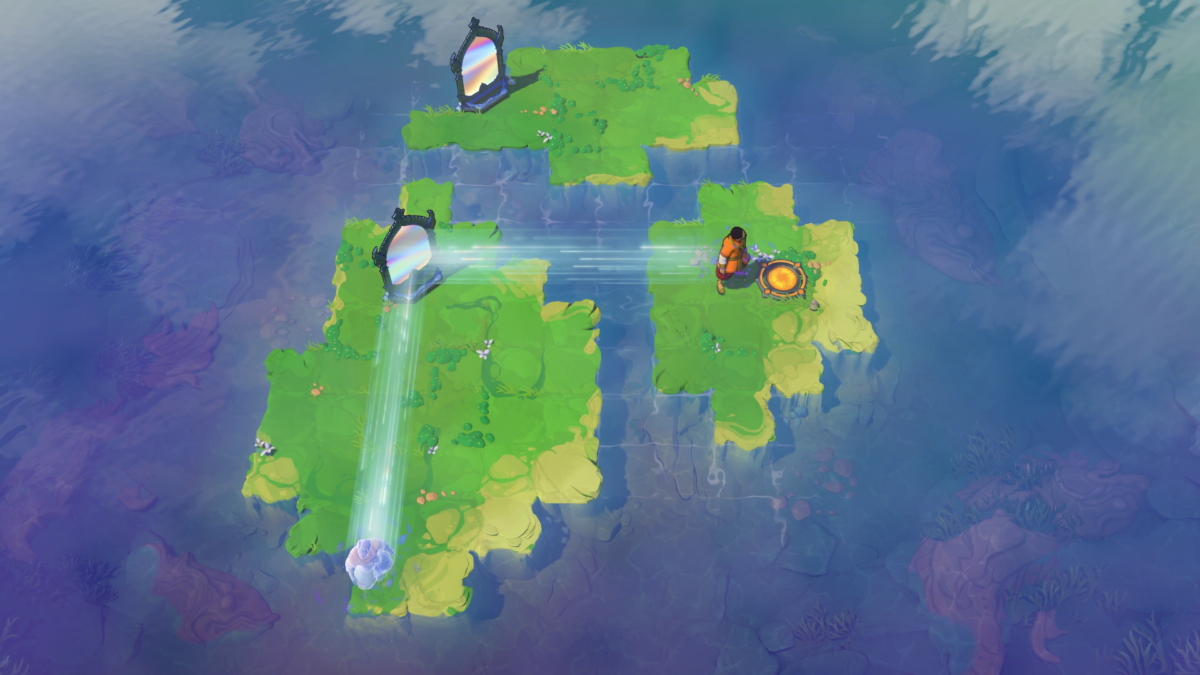
If we need to decide how a magic mirror should behave in a certain situation, I tend to discuss that with the other designers on this game. Usually we have roughly the same opinion, so it’s not like there are huge arguments, but it is a different process. On The Witness or Braid, I would just think about it by myself and make the decision.
I think I prefer the solo process a little bit, honestly. But there is something really good about collaboration that you don’t get by yourself: you immediately get a double-check on things.
In puzzle design, it’s very common to make a puzzle and think, “The player will have to be really smart and do this, and then this, and then this.” Then someone else plays it and solves it by pushing one rock into the water somewhere, and you realize the puzzle is broken. There’s a kind of designer blindness that happens because you know what’s supposed to happen, so you don’t always see what can happen.
With multiple designers, you get that check. They don’t know exactly what you were thinking when you made the level, so they can find things you missed. That’s very valuable. And the designers I work with day-to-day are some of the best designers in the world, so it’s really nice to have those conversations.
OUTPUT LAG: Assuming the game works somewhat like The Witness, where you have a large world and some freedom in the order you tackle things, how do you make sure the experience stays strong for someone who goes one direction versus someone who goes another? Especially once the worlds start combining?
JONATHAN BLOW: That’s one of the things we spend a lot of time thinking about and planning.
For the first part of the game, the topics are mostly quarantined. If you go west, you won’t have the mechanics you would have seen by going east. Eventually, as you said, they come together. But they come together at specific gold rooms on the overworld.
For example, if you want to enter a southwest combination area, you can’t get there without opening the gold room first. To open that room, you need to have gone west and gone south. Once you’re in that territory, it’s fair game to use anything from the west and south, because the player has already seen those mechanics.
Later in the game, it gets more complicated. We have some places where you can’t enter a room unless you’ve done something else far away. When that happens, the game gives you an arrow showing what you need to do first. But that’s actually pretty rare. Most of the structure is handled by how the world and the gates are arranged.
OUTPUT LAG: With so many puzzles in the game, is there one that stands out as a favorite? Either from a design standpoint or just because of how it executes an idea?
JONATHAN BLOW: There are definitely a couple that are favorites. That happens on every game.
It’s hard to explain why without getting into mechanics you don’t know yet because you haven’t played it. But one of them is a level called “Magnitudes.” I designed it originally, and then someone else on the team redesigned it. Without giving anything away, it takes one of the teleportation mechanics in the game and gets really crazy and excessive with it — to an extreme degree.
It’s an epically big level, but everything you do in it still makes sense and is organized. That’s probably my favorite.
OUTPUT LAG: That sounds awesome. Jonathan, thanks so much for your time. I’m excited to check it out. It looks like a lot has gone into every aspect of it, and I’m looking forward to being frustrated, but also feeling very accomplished after completing some of these puzzles.
JONATHAN BLOW: Right on. Thanks for your time today.
That pick-up-and-play structure should also make Order of the Sinking Star a natural fit for Nintendo Switch 2, where Arc Games and Thekla have now confirmed the game will launch later this year. Blow pointed specifically to the game’s scale and portability as a strong match, noting that its “many, many puzzles” can be tackled in short bursts or longer sessions. Alongside its Steam release and Steam Deck support, the Switch 2 version gives this massive puzzle adventure another fitting home; one where players can chip away at its world whenever, and however, they want.
Order of the Sinking Star sounds, in the best and most dangerous way, like the kind of game that grew because its ideas demanded it. What began as a supposedly smaller puzzle project has become a massive exploration of mechanics, combinations, story fragments, and design discipline.
Just as interesting, though, is how much of the conversation came back to restraint: cutting unnecessary frustration, organizing difficulty around ideas, and making sure the game earns its size. If Braid and The Witness were already proof that Blow is willing to chase a design concept to its limit, Order of the Sinking Star may be his most exhaustive version of that philosophy yet.