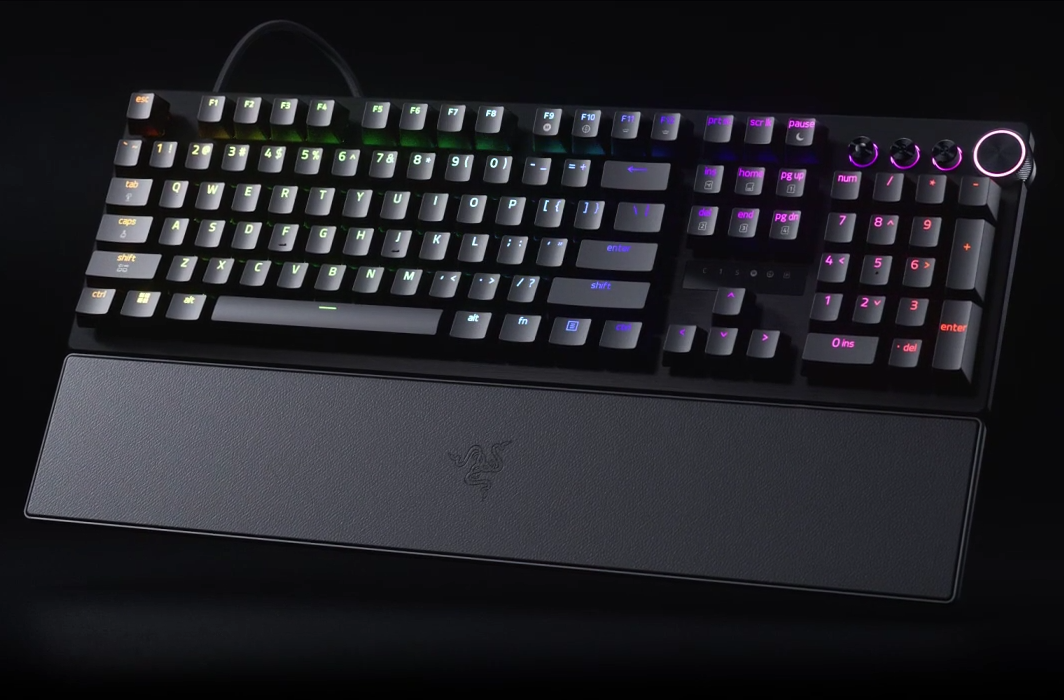

I’ve spent just over three weeks with the fastest mainstream keyboard money can buy, and I’m genuinely impressed. The Razer Huntsman V3 Pro does everything it promises, surprisingly still impressing me even three weeks later. It’s a keyboard that can register your keypress in 0.125 milliseconds, detect actuation at a hair-trigger 0.1mm of travel, and reset faster than you can blink. It’s also a keyboard where those advantages exist almost entirely on paper for the overwhelming majority of players who will buy it, but for a very active but certainly not professional gamer like myself, I’ve still grown to love the Huntsman V3 Pro 8KHz.
This Spec Sheet That Launched a Thousand Arguments
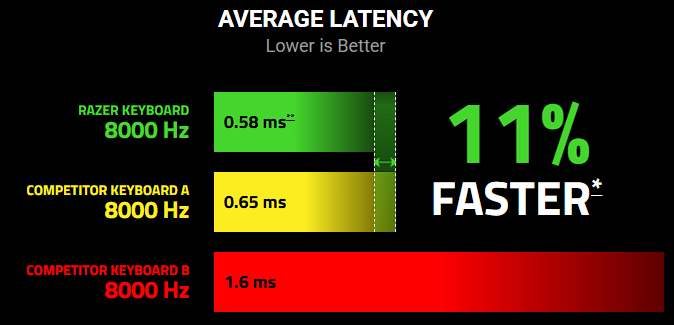
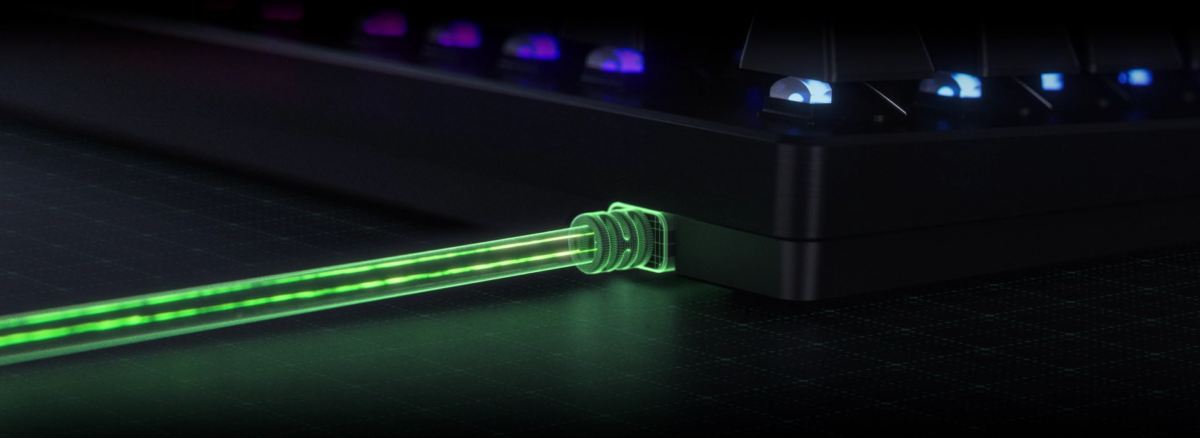
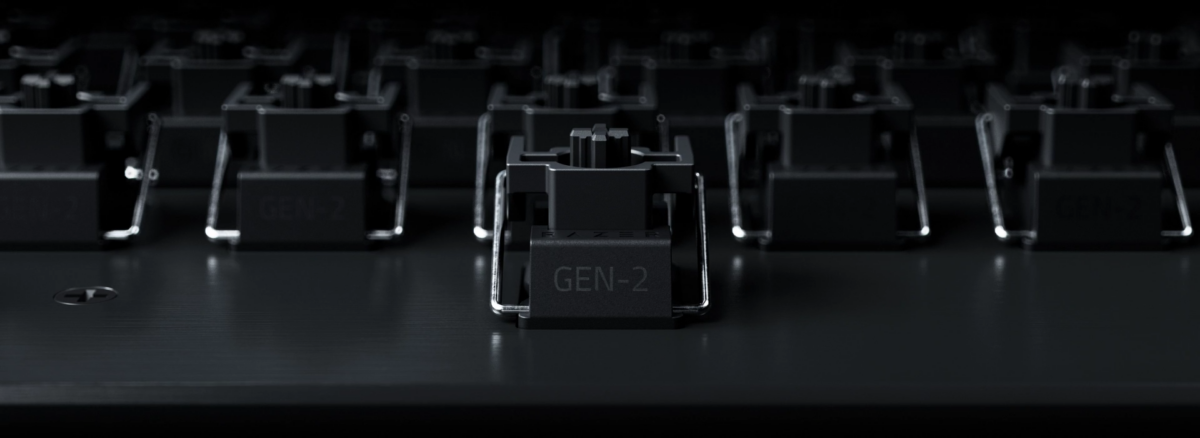
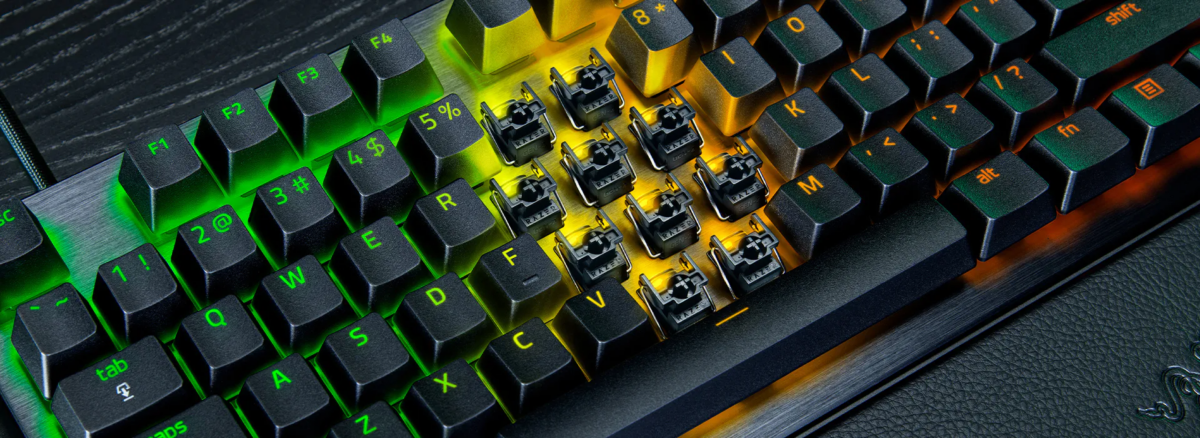
Let’s talk numbers, because they are certainly worth talking about. The Huntsman V3 Pro features an 8000Hz polling rate, which means it communicates with your PC eight thousand times per second. Standard keyboards poll at 1000Hz—so on paper, you’re looking at an 8x improvement in response time, dropping from 1ms to 0.125ms. Razer’s second-generation optical analog switches offer adjustable actuation from 0.1mm all the way to 4.0mm, letting you essentially decide how much you need to press a key before it registers. These are impressive specifications that would have seemed like science fiction five years ago.
The headline feature for competitive players is Rapid Trigger, which eliminates the traditional requirement of fully releasing a key before you can press it again. On a standard keyboard, you press a key down, and it stays “pressed” until you release it past a reset point. Rapid Trigger changes the game by letting the key reset the instant you start lifting your finger, enabling impossibly fast repeated inputs. Combined with that 0.1mm actuation point, you can theoretically tap keys faster than any mechanical switch would allow.
Reading these specs feels like looking at a competitive gamer’s fever dream made manifest. In an admittedly non-competitive environment, I’ve been using the keyboard in, the gap between theoretical advantage and practical benefit is there. But that’s not to say the keyboard doesn’t work and feel great. I have no clue if I’m noticing a difference with such a high polling rate, but what I do know is that it is extremely responsive which is the end goal.
What Your Fingers Actually Feel
Setting aside the numbers for a moment, the Huntsman V3 Pro is a premium piece of hardware. The aluminum top plate construction gives it a satisfying heft, and the overall build quality reflects the price point in ways you can immediately feel. The included magnetic plush leatherette wrist rest is a thoughtful addition that actually enhances the experience rather than feeling like a throwaway accessory. This is a keyboard that feels expensive because it is expensive, and in that regard, Razer delivers in troves.
The optical switches themselves are smooth, possibly almost too smooth for some users. If you’re coming from tactile mechanical switches and enjoy that satisfying bump on each keystroke, you’ll find the Huntsman’s linear optical switches somewhat lacking in character. They’re fast and consistent, but they won’t satisfy the mechanical keyboard enthusiasts who prize feel over function. For pure gaming purposes, the smoothness is arguably a benefit, but day-to-day typing can feel a bit sterile. The multi-function digital dial and dedicated media keys work flawlessly, adding genuine utility beyond gaming.
Razer Synapse, the company’s configuration software, offers tremendous depth for customization. You can adjust actuation points per-key, create complex macros, tune the per-key RGB lighting with Chroma integration, and dial in exactly the behavior you want. The flip side is that Synapse can feel overwhelmingat times. It’s powerful software that assumes you want to spend time configuring rather than just playing. Beneath all the software complexity, this is an excellent keyboard for both gaming and productivity work.
The 8000Hz Emperor Has No Clothes
Lert’s talk about the potential elephant in the room: human reaction time averages somewhere between 150 and 250 milliseconds. We’re talking about a keyboard that shaves fractions of a single millisecond off your input latency, marketed to humans who physically can’t react in under 150 milliseconds. The math may or may not work, admittedly that’s for someone who makes a lot more money than me to decide. The 8000Hz polling rate sounds impressive until you realize we’re arguing about improvements measured in tenths of milliseconds when your brain operates on a timescale hundreds of times slower.
I tested this keyboard extensively in both FPS games like Counter-Strike 2 and Valorant, games where input latency theoretically matters most. In blind tests (well to me at least) switching between 1000Hz and 8000Hz polling without knowing which was active, I could not always consistently identify which setting was enabled. That being said, the osu! rhythm game community has conducted rigorous testing of high polling rate peripherals, and while they’ve found measurable benefits, those benefits require a level of perceptual sensitivity that borders on superhuman. For the vast majority of players, 8000Hz may be indistinguishable from 1000Hz in actual gameplay. But once again, that doesn’t make the keyboard any less great.
The technology works exactly as advertised, but the argued benefit may not translate to meaningful real-world improvement for most gamers.
Where Rapid Trigger Actually Matters
If the polling rate is a bit overstated, the Rapid Trigger is the genuine innovation worth paying attention to. Counter-strafing in CS2—the technique of quickly tapping the opposite movement key to stop your character’s momentum for accurate shots—is noticeably smoother with Rapid Trigger enabled. This isn’t a subtle difference; the keyboard actually lets you execute movement techniques that are physically impossible on traditional switches. When you need to tap A-D-A-D in rapid succession, not having to fully release each key before re-pressing transforms how the game feels.
Fortnite boasts similar benefits from the analog input modes, which allow for variable movement speed based on how far you press a key—essentially giving keyboard players the analog movement that controller users have always enjoyed. The 0.1mm actuation point enables techniques that simply can’t exist on mechanical keyboards with their longer travel distances and fixed actuation points. These are real advantages with real applications.
Razer executed Rapid Trigger well—it works reliably and the Synapse integration is solid. Credit where it’s due: the implementation is polished and the feature is useful for competitive players who understand what it actually does.
The $250 Question
At $249.99, the Huntsman V3 Pro sits at the premium end of an increasingly competitive market. T You’re not paying $250 purely for performance—you’re paying for the Razer name and quality, the Chroma RGB ecosystem, and the brand recognition that comes with the triple-headed snake logo.
What you do get for that premium is build quality that matches the price, a useful wrist rest, and integration with Razer’s broader peripheral ecosystem. The aluminum construction feels more substantial than plastic competitors, and the overall fit and finish reflects careful attention to detail. In essence, this is exactly what you’d expect a $250 keyboard to look and feel like.
Who The Huntsman V3 Pro 8000KHz Keyboard Is Actually For
The Huntsman V3 Pro makes perfect sense for Razer ecosystem users who want flagship-level everything and appreciate the unified software experience, as well as competitive players who specifically understand and need rapid trigger functionality and want it wrapped in premium hardware. It’s also for enthusiasts who simply want the best-built version of this technology, regardless of diminishing returns. If you fall into one of these categories, you’ll be extremely happy with this purchase.