 By
By This review follows Output Lag’s comprehensive review methodology.
About THYSIASTERY
- Developer
- DIRGA
- Publisher
- DIRGA
- Release Date
- March 9, 2026
- Platforms
I don’t play a ton of dungeon crawlers. I’ll be the first to admit it. The Wizardry lineage, the Etrian Odysseys, the grid-based blobbers of the late ’80s and early ’90s — I respect the genre more than I frequent it. And I think that’s true for most people my age. If you’re Gen Z and someone says “first-person dungeon crawler,” your frame of reference is probably a YouTube video essay about Wizardry rather than any actual hours spent mapping corridors on graph paper.
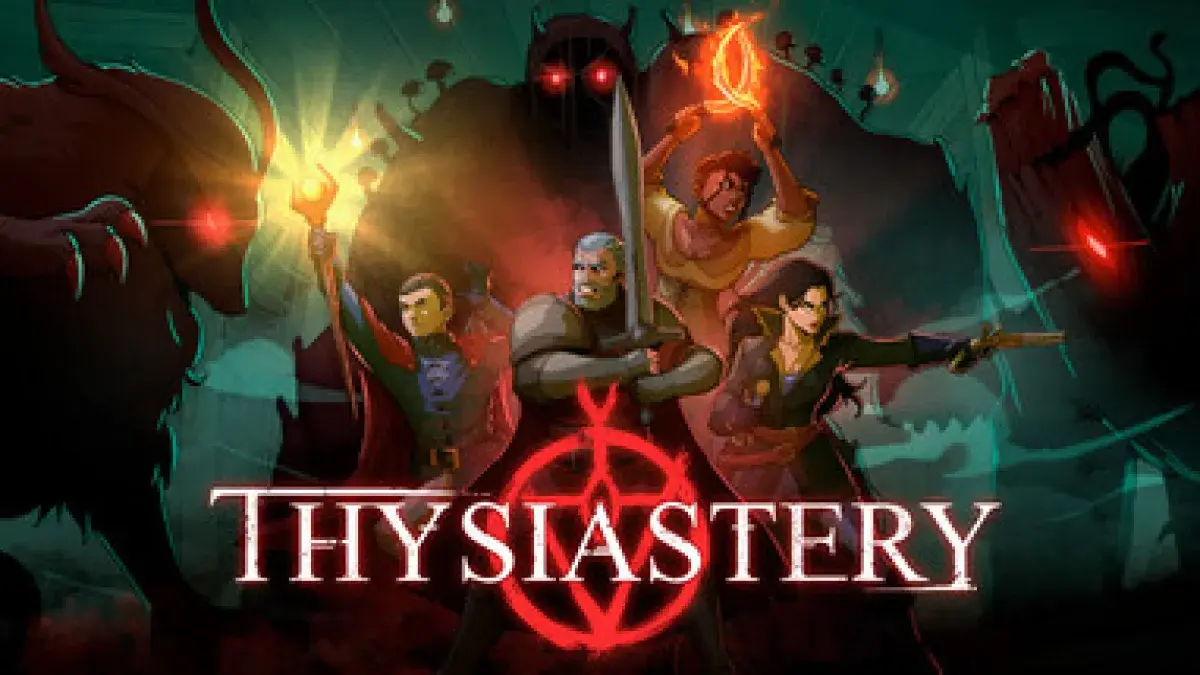
The genre has spent decades speaking almost exclusively to the people who grew up with it, and the result is a catalog that — while deep — feels largely frozen in amber. There’s a real hunger for dungeon crawlers that keep the mechanical soul of the genre intact while making it feel fresh, accessible, and worth engaging with in 2026. THYSIASTERY, the debut title from Finnish indie studio DIRGA, isn’t a perfect answer to that hunger, but it’s a promising one — and it’s a sign that developers are starting to meet the genre where a new generation actually lives.
Dithered to Perfection
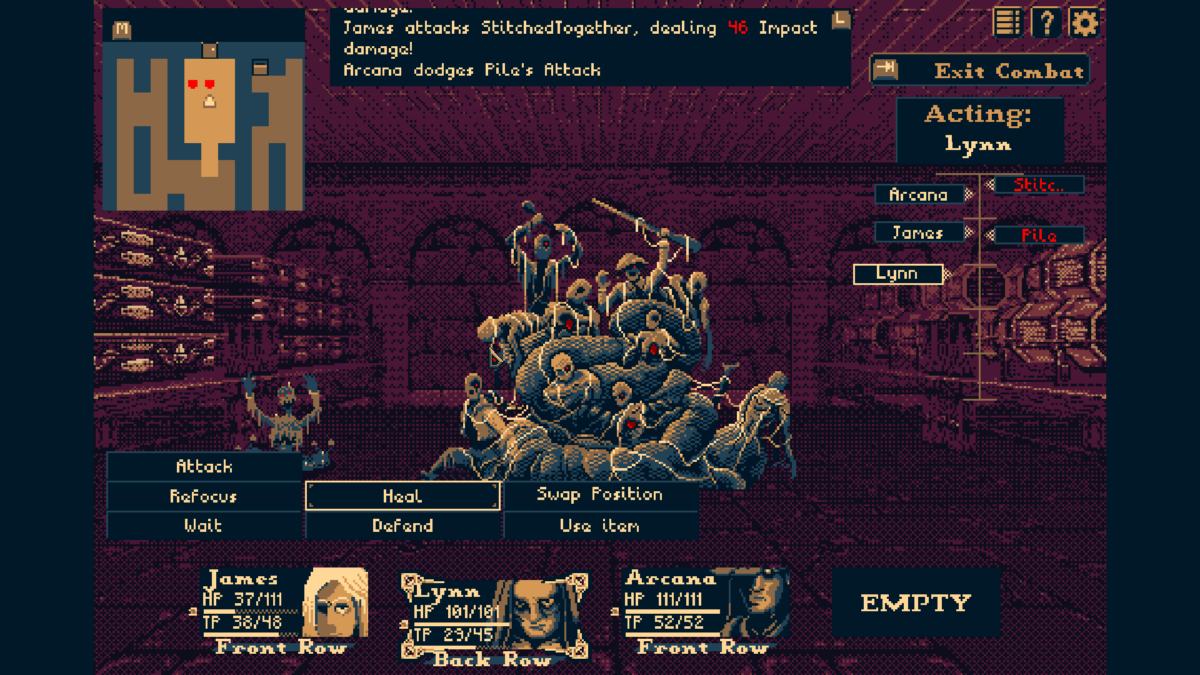
The premise is lean and moody. You control a party of four characters — Bearers of the Brand — who’ve been drawn into a vast, procedurally generated underworld called the Labyrinth. There’s no lengthy tutorial. No hand-holding. You explore grid-based environments in first person, recruit characters you find along the way, and try to push deeper through strata of buried forests, underwater cities, and ancient ruins that feel genuinely varied despite the roguelike scaffolding underneath. The tone sits somewhere between dark fantasy and cosmic horror, with enemy designs that pull from places you wouldn’t expect — classical fantasy fare sits alongside Lovecraftian nightmares and WW1/WW2-inspired monstrosities. It’s a wild mix, and it works far better than it has any right to.
Let’s talk about the art, because it deserves its own paragraph. THYSIASTERY is rendered in a limited-palette pixel art style with swappable color presets — twelve of them — and every single one looks like a lost SNES cartridge you’d find in a box at a flea market and immediately know was special. The dithering effect used to simulate light and shadow in the dungeon corridors is genuinely beautiful. It breathes. The backgrounds shift and pulse in a way that makes the Labyrinth feel alive rather than procedurally assembled, and the enemy portraits are detailed enough to make each new encounter feel like an event. Stellar doesn’t quite cover it. This is one of the best-looking pixel art games I’ve played this year, full stop.
Smart Systems, Heavy Dice
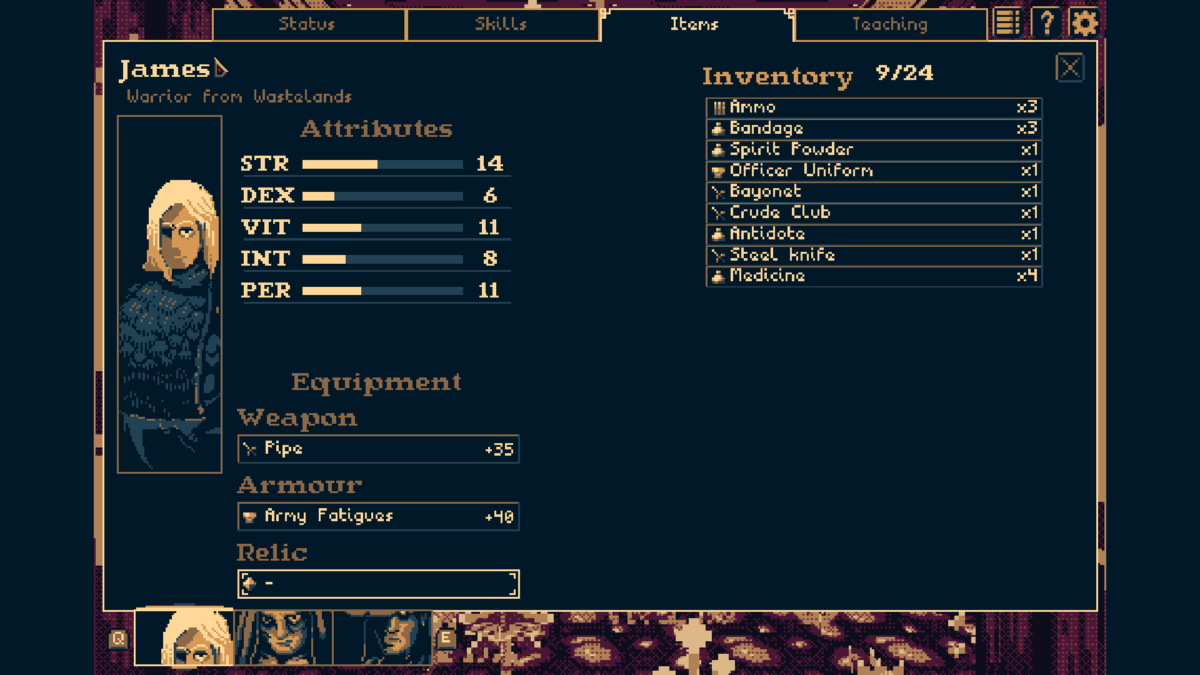
The standout mechanical hook is the skill teaching system. Characters can learn abilities through leveling and exploration, then pass those skills to other party members. It creates a metagame layer that rewards experimentation across runs — you’re not just grinding for stats, you’re building institutional knowledge within your party. Combine that with a permadeath system that operates on escalating risk — when a character gets KO’d, they accumulate wounds that increase their chance of dying permanently on the next knockout — and you get a tension loop that feels meaningfully different from the binary alive-or-dead model most roguelikes use. It’s clever design, and it’s the kind of thing that makes you want to push just one more room deeper.
Here’s where it gets complicated, though. The RNG in THYSIASTERY is heavy-handed in a way that frequently undermines the strategic depth it’s clearly trying to offer. Some enemies can flatline your entire party if you don’t have the exact right composition or equipment — and there aren’t a ton of ways to prepare for those encounters beforehand. The game doesn’t give you enough information or tools to meaningfully strategize before combat. You’re often just walking into a room and hoping the loot drops and random events from the last several floors gave you what you need. When it works, it feels like a hard-won victory. When it doesn’t, it feels like the Labyrinth decided you were losing this run three floors ago and you just hadn’t realized it yet. That’s a frustrating dynamic in a game that asks for permadeath commitment.
The content ceiling is also noticeable. After a handful of runs, the procedural generation starts showing its seams. You’ll recognize the stratum patterns, the event types, the general rhythm of what the game throws at you. There’s enough variety in enemy design and loot to keep things interesting for a while, but not enough to sustain the kind of deep, dozens-of-hours engagement that the best roguelikes demand. It needs more — more encounters, more event variety, more ways to interact with the Labyrinth between combat — and at $12.99 (currently $9.09 with the introductory discount), that’s a reasonable ask rather than a dealbreaker.
A Perfect Pocket Dungeon (In Small Doses)
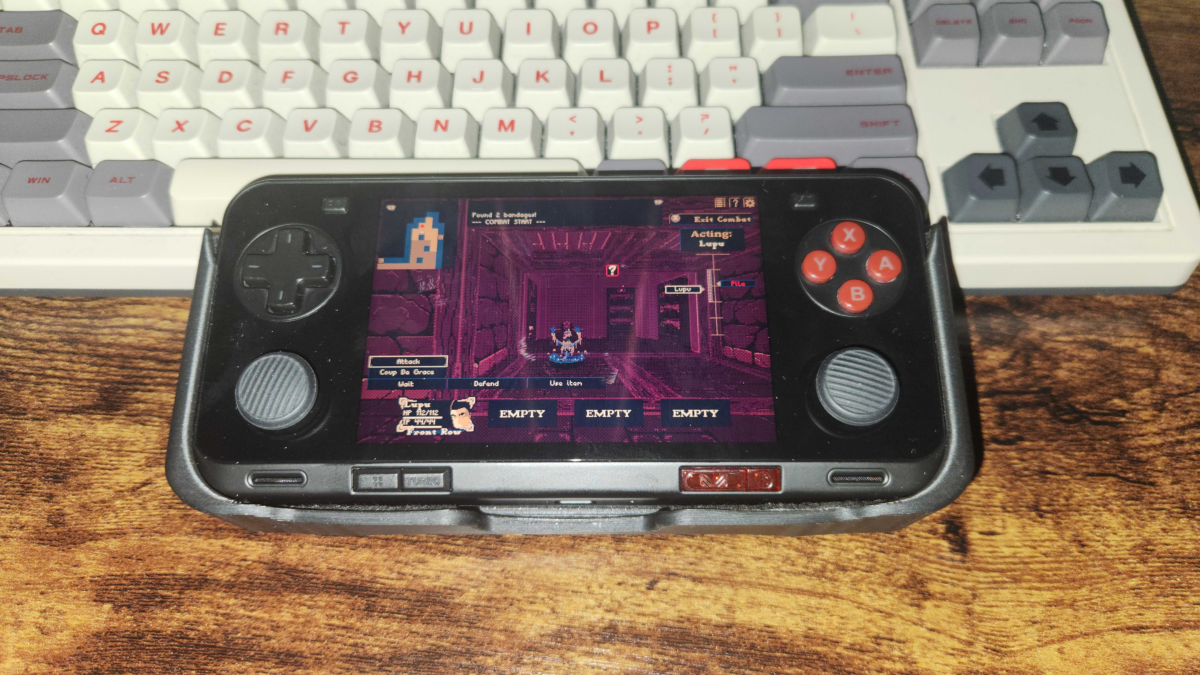
One thing worth mentioning — I played this entirely on my AYANEO Pocket ACE via GameNative, which runs Steam games locally on Android hardware without streaming. THYSIASTERY is an ideal candidate for this setup. It’s lightweight at just 1 GB, the turn-based pacing means input latency is a non-issue, and the pixel art looks phenomenal on the Pocket ACE’s sharp 4.5-inch IPS display. It’s a fantastic pocket game in short sessions — perfect for a commute, a lunch break, a quick run before bed. Where it loses steam is in longer sittings, where the content repetition and RNG frustrations compound and the magic starts to thin. Twenty minutes at a time? Excellent. Two hours? You’ll feel the walls closing in, and not in the atmospheric way DIRGA intended.
A Rising Tide for Blobbers
THYSIASTERY is a good game right now and a potentially great one in a few updates. The foundation — the art, the skill teaching system, the wound-based permadeath, the sheer vibe of the Labyrinth — is rock solid. What it needs is more of everything that sits on top of that foundation: more content, more encounter variety, more player agency before combat, and a gentler hand on the RNG dial. The timing might work in its favor, too. With poncle’s Vampire Crawlers — the first-person dungeon crawling spin-off of Vampire Survivors — on the horizon and already pulling 358,000 demo downloads during Steam Next Fest, the blobber genre is about to get more mainstream attention than it’s had in decades. That’s a rising tide that could lift a game like THYSIASTERY significantly, especially among players who try Vampire Crawlers, discover they actually enjoy crawling dungeons from a first-person grid, and want something darker and more mechanically earnest to sink into next.
The dungeon crawler genre is overdue for a modern renaissance, and DIRGA is clearly building something worth paying attention to. They just need to fill out the edges. If you’re a dungeon crawler devotee, this is an easy recommendation at its current price. If you’re genre-curious like me, it’s worth the trip — just don’t expect the Labyrinth to keep you forever. Not yet, anyway.
This review is based on a retail build of the game provided by the publisher.