
There’s a particular tension in tactical roguelites that separates the forgettable from the magnetic: the constant negotiation between calculated positioning and chaotic improvisation. You think you’ve solved the puzzle, arranged your pieces perfectly—and then the game throws a wrench into your beautiful plans, forcing adaptation on the fly. Blightstone, which just launched into Early Access from Barcelona-based studio Unfinished Pixel, understands this dance intimately, wrapping it in a dark fantasy package that commits fully to its apocalyptic premise without ever winking at the camera.
Save the Crystal, Save the World
The setup is refreshingly direct: escort the Earthglass Crystal through a corrupted realm to the Infernal Rift, destroy the demon overlord Korghul, and shatter the Blightstone itself. It’s essentially a tactical escort mission stretched across an entire roguelike structure—and if that description triggered some protective instincts, Unfinished Pixel seems acutely aware of the pitfalls. The Crystal isn’t just a helpless burden to babysit; it’s an active participant in your strategy, capable of wielding its own unlockable skills. The catch? It can’t move on its own, and if it dies, your run dies with it. This constraint transforms every encounter into a spatial puzzle where offense and defense constantly compete for your attention.
Grids Are Dead, Long Live Free Movement
What immediately distinguishes Blightstone from its grid-based contemporaries is the free movement system. There’s no clicking squares here—you’re positioning your party of three heroes with the kind of spatial freedom that transforms each encounter into something closer to a real-time tactics game frozen in amber. Enemies exploit the same freedom, creating firefights where angles matter more than abstract tile counts. Every action costs Action Points, including movement, which means every step carries weight and poorly planned advances get punished by backline divers exploiting gaps in your formation.
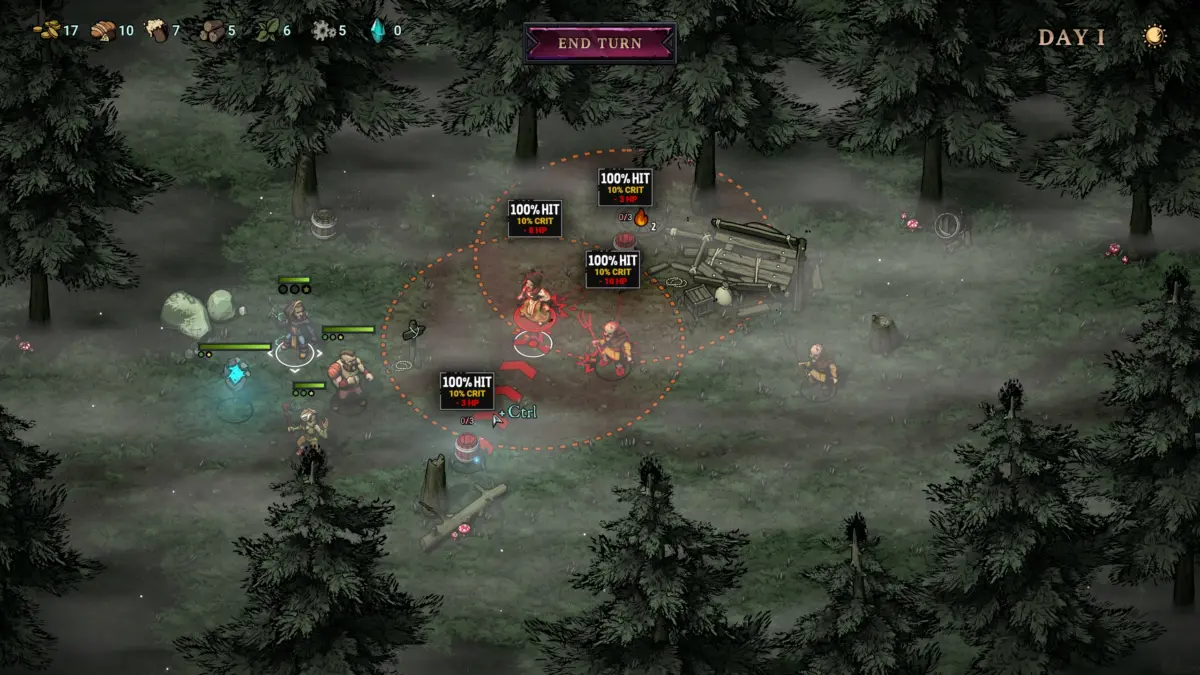
Let me paint a picture from my third run. I’d finally unlocked the Arcanist’s chain lightning ability, and a cluster of bandits had foolishly grouped near a shallow stream. The tactical opportunity was obvious—electrify the water, watch the damage cascade through their ranks. I repositioned my Hunter to flank, had his dog draw aggro, and lined up what should have been a devastating combo. Then the weather shifted. Rain began falling, amplifying electric damage across the entire battlefield. My Arcanist’s lightning hit the puddle, arced through four enemies, and then—because I’d forgotten my Brawler was standing in adjacent mud—chained directly into my own frontliner. One beautiful, catastrophic miscalculation. The environmental interactivity cuts both ways, and Blightstone is more than happy to let you hang yourself with the rope it provides.
The environmental systems run deep. Tall grass provides concealment until someone decides to set it ablaze, eliminating cover for both sides. Quicksand and bottomless pits become tactical tools—use telekinesis to drop an enemy into oblivion, or watch helplessly as your Brawler gets dragged into the same hazard. Dynamic weather compounds these layers: dense fog obscures sightlines, rain amplifies electric attacks, and strong winds introduce accuracy penalties that can turn a sure hit into a desperate whiff.
A Party Worth Dying For (Repeatedly)
You begin with three unlocked classes—Brawler, Hunter, and Arcanist—with the Druid and Priest requiring specific quest completions to access. Each brings genuinely distinct tactical vocabulary: the Hunter coordinates attacks with a companion dog and sets traps, the Arcanist chains lightning through clustered enemies, the Brawler slams foes into walls for bonus damage. The interplay between classes creates satisfying emergent moments, though the early game grind to unlock new skills through the Continuum Forge feels notably slow. Progression currency called “Strands of Time” trickles in at a pace that can make the first several hours feel repetitive—a point of friction visible in the game’s current Mixed review score on Steam.
The Elephant in the Rift
That Mixed rating (currently 60% positive) deserves honest acknowledgment. After roughly ten hours, the content pool—five biomes, three main bosses, two mini-bosses, and enemies ranging from dwarves to massive scorpions—starts to feel familiar. Some players report the meta-progression feeling like a grind for its own sake, and the inability to skip repetitive opening dialogue on each new run adds unnecessary friction. The roadmap promises two new heroes, thirty new items, additional enemy factions, and a new story act, which should address the variety concerns if Unfinished Pixel delivers.
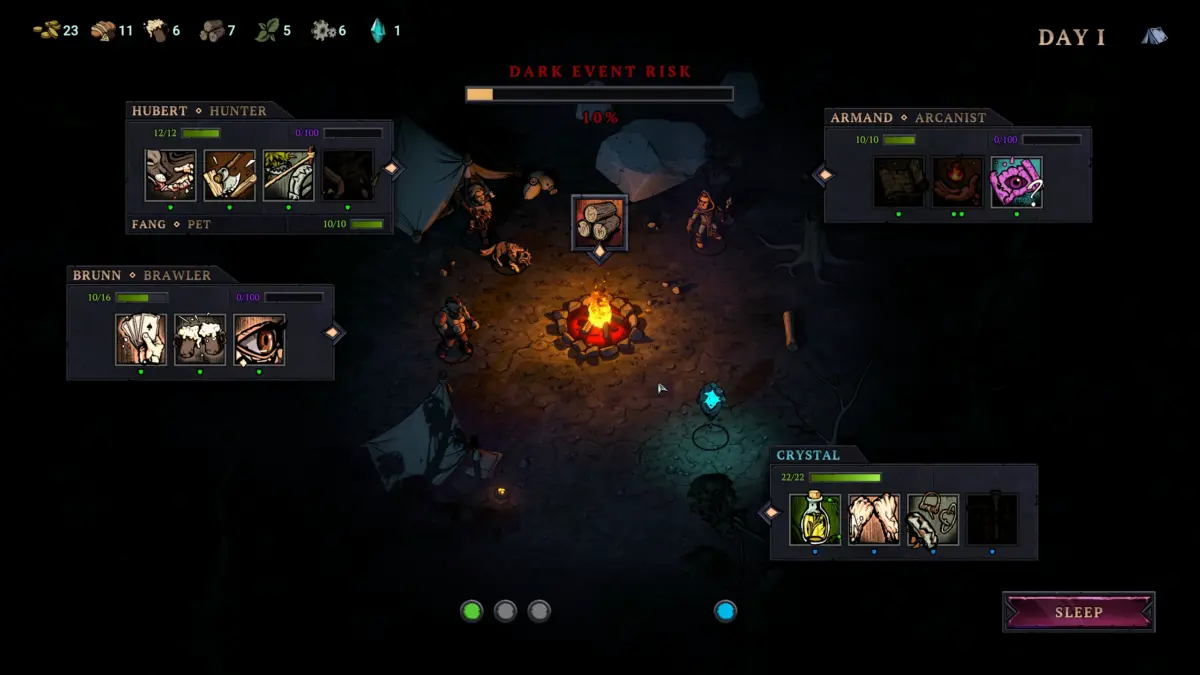
Between battles, you’ll manage your party via the Camp system. During night cycles, characters perform specific tasks: the Hunter gathers wood, the Brawler heals the party, and the Arcanist purges “Blight”—a debuff that accumulates over time. These actions rely on limited resources like food, wood, and herbs gathered from combat, making every decision a high-stakes balancing act that extends the strategy beyond just the tactical layer.
The Verdict (So Far)
At $15.99 (currently 20% off for the launch window), Blightstone represents an interesting gamble for tactics enthusiasts. The gridless combat feels genuinely fresh, the environmental interactions reward creative problem-solving, and the Crystal escort mechanic adds meaningful stakes to every encounter. Whether it reaches its potential depends entirely on the Early Access runway—the developers have committed to 6-12 months of active development, and community feedback is already shaping their priorities.
A promising tactical roguelite with a strong mechanical foundation and meaningful environmental depth. The early grind is real and content variety is currently thin, but the systems are in place for something special. Worth watching closely—and worth jumping in now if you’re the type who enjoys shaping a game’s development through feedback.