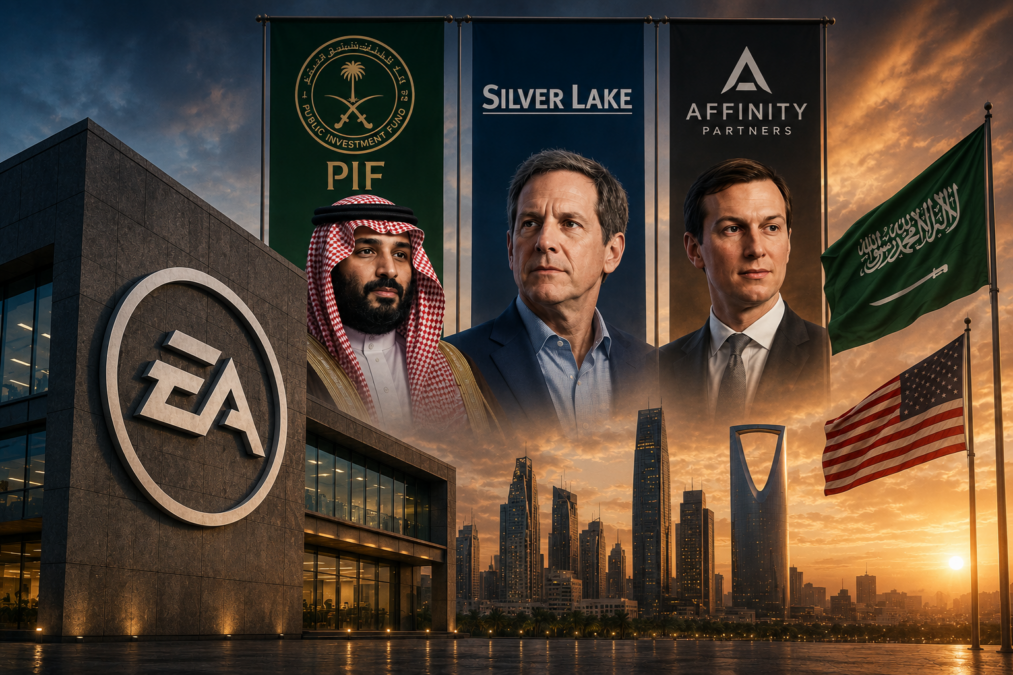
Electronic Arts announced today that its $55 billion sale to Saudi Arabia’s Public Investment Fund, Silver Lake and Jared Kushner’s Affinity Partners has closed. Shareholders will receive $210 per share. As a result, EA will disappear from Nasdaq and public trading completely. Chief executive Andrew Wilson will remain in charge, promising bold investment, accelerated innovation and a new generation of experiences.
The language itself is admittedly reassuring, especially when the industry as a whole seems rather bleak. The ownership structure, however, is considerably more consequential.
EA calls its buyers a “Consortium,” a word that suggests three partners sitting around the same table with roughly comparable influence. The most detailed public disclosure, however, tells a different story. According to a Brazilian antitrust filing reported by The Wall Street Journal, PIF is expected to own 93.4% of the private company. Silver Lake would hold 5.5%, and Affinity Partners just 1.1%.
This is not, in any meaningful economic sense, a three-way takeover. It is a Saudi sovereign acquisition with two American partners. Not quite a “Consortium” at least in the broad sense.
That distinction matters because EA is not an ordinary collection of software assets. Its games shape global sports culture, online communities and popular storytelling. EA Sports FC, Madden NFL, The Sims, Battlefield, Apex Legends, Mass Effect and Dragon Age collectively reach hundreds of millions of people. Some are competitive platforms. Some are social spaces. Some allow players to explore identity, relationships, politics and morality. And despite the many grievances gamers have had towards EA over the decades, their size has allowed them to take some risks and be a little more adventurous at times when trying out new IPs.
The new owner is equally unusual. PIF is not simply a large pension fund seeking diversified returns. It is Saudi Arabia’s sovereign wealth fund, chaired by Crown Prince Mohammed bin Salman and central to his Vision 2030 program. Its mission combines investment performance with the transformation and international projection of the Saudi state. Through Savvy Games Group, PIF already controls Scopely and ESL FACEIT and is attempting to establish Saudi Arabia as a global center of gaming and esports. EA is now the crown jewel of that strategy, front and center.
To be completely fair, there is a credible optimistic case for this transaction.
Public markets often punish game publishers for the long, uncertain development cycles required to create ambitious games. Patient capital could give EA’s studios more time, better technology and room to undertake projects that do not produce immediate quarterly revenue. PIF has the resources and strategic appetite to invest for years. Silver Lake has decades of experience working with major technology and entertainment businesses. Going private could free EA from the ritual of managing every creative decision around the next earnings call.
But the financial structure points in the opposite direction.
The buyers committed roughly $36.4 billion in equity and arranged $20 billion in acquisition debt. EA is therefore beginning its promised age of creative investment beneath one of the largest debt packages ever placed around a buyout.
EA generated approximately $7.5 billion in revenue in its latest fiscal year, but only about $1.16 billion in operating income. Roughly 71% of its revenue came from live services and other ongoing digital products. Those figures help explain why investors value EA: its sports franchises and recurring digital purchases produce reliable cash. They also reveal the danger. A company expected to service a massive acquisition financing will face strong incentives to favor predictable sequels, recurring monetization and established intellectual property over expensive creative experiments.
While that alone does not make cuts, cancellations or more aggressive monetization inevitable, it certainly makes them financially tempting.
Silver Lake chief Egon Durban added another loaded word to the announcement: artificial intelligence. He said the buyers intend to invest in what AI can do for game development and the player experience. AI may indeed help artists prototype environments, improve accessibility, test complex systems and reduce repetitive work. It can also be used to reduce head count, weaken the bargaining position of creative workers and flood games with cheaper synthetic content.
In a lightly leveraged company, promises of AI investment might be evaluated principally as a technology strategy. In a company surrounded by $20 billion in acquisition financing, employees are entitled to ask whether “efficiency” is a synonym for fewer jobs. EA and its owners should answer before restructuring begins, not after. But let’s be honest: they won’t.
The political questions are harder still.
Mohammed bin Salman is not a distant beneficiary whose identity has no bearing on the investment. He chairs the fund that is expected to own almost all of EA. The U.S. intelligence community concluded that he approved the operation to capture or kill journalist Jamal Khashoggi. Human-rights organizations continue to document the Saudi government’s repression of peaceful dissent and criticize the use of international entertainment investments to soften perceptions of that record.
None of this proves that Riyadh will dictate the story of the next Mass Effect, remove same-sex relationships from The Sims or turn Battlefield into propaganda. Predictions stated as certainties would be irresponsible. But dismissing the issue because no interference has yet been demonstrated would be equally naïve. Ownership is power, even when that power is exercised through budgets, appointments and incentives rather than direct edits to a script.
Affinity Partners adds another layer. Its founder, Jared Kushner, previously served as a senior White House adviser and remains an informal participant in international diplomacy. PIF committed $2 billion to his investment firm, and Kushner reportedly helped broker the EA transaction. Affinity’s ownership percentage is tiny, but its role illustrates how state capital, private investment and political relationships increasingly overlap. As scary a time as ever to not be a billionaire.
EA’s management and new owners can address these concerns, but slogans about creativity will not be enough.
They should disclose the new board and the voting rights held by each investor. They should publish a binding creative-independence policy covering political, religious and LGBTQ-related content. They should explain how player data will be governed and whether it can be accessed by, transferred to or analyzed for any government-linked entity. They should establish clear limits on the use of generative AI, including protections for jobs, credits and the intellectual property of employees and performers. They should report studio closures, major layoffs and related-party transactions with the same seriousness expected of a public company.
These would not be extraordinary burdens. They would be reasonable protections for a company whose products function as global cultural spaces.
There is also reason to scrutinize how the sale itself was conducted. EA’s proxy materials show that its board chose not to contact other potential buyers before signing, concluding that another party was unlikely to match the consortium’s price and certainty of closing. Shareholders received a substantial premium, and Goldman Sachs delivered a fairness opinion. Yet the absence of a broad pre-signing auction means the public cannot know whether a different buyer—or a different structure involving less debt—might have emerged.
For shareholders, the transaction is over. They receive their cash and surrender any participation in EA’s future growth. But for players and employees, the transaction is just beginning.
PIF, Silver Lake and Affinity Partners may prove to be genuinely patient owners. They may give EA’s developers resources that public markets would not. They may use AI responsibly. They may protect the identity of franchises whose appeal depends on openness, experimentation and global communities.
But those outcomes should be judged by governance and behavior, not by a surely multi-PR approved closing-day press release.
EA has spent decades asking players to invest emotionally, socially and financially in its worlds. Now the company’s owners are asking those players to trust a record-setting leveraged buyout, a sovereign fund closely identified with an authoritarian government, a politically connected investment firm and an AI-centered growth strategy.
Trust at that scale cannot simply be announced.
It has to be earned.